

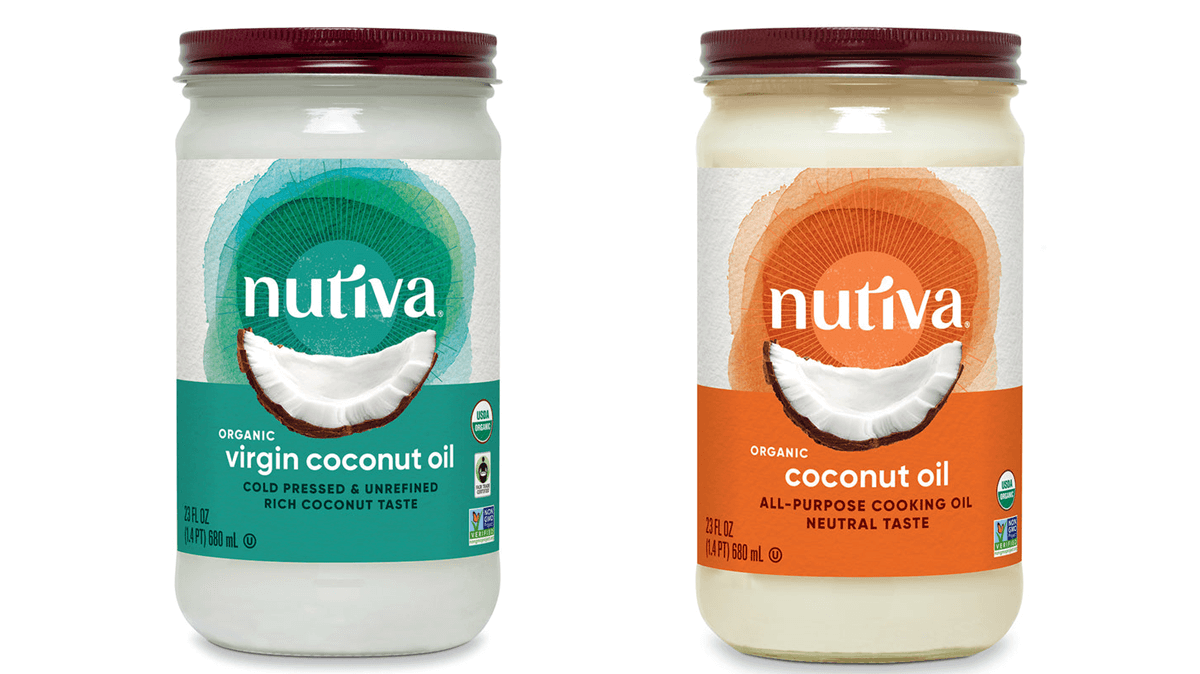
This post takes a look at Nutiva coconut oil from an ethical perspective. It originally examined a refined coconut oil but it looks like Nutiva discontinued that product. This doesn’t matter too much since the point of these examples is to provide mini case studies on examining the social and environmental impact of a company or product. Nutiva do still make other coconut oil products and the information below still applies.
It’s another example of how to incorporate both gold star and green star ratings in your product reviews. You can see more examples here. Below the review there’s some more detail on the information sources. I usually don’t include citations (i.e. the information sources) in the review since links are often not accepted on review sites. But there should be enough factual information to allow readers to find the information themselves, should they want to know more.
Review of Nutiva refined coconut oil
Ratings: ***** (5/5 Gold stars) / ***** (5/5 Green stars)
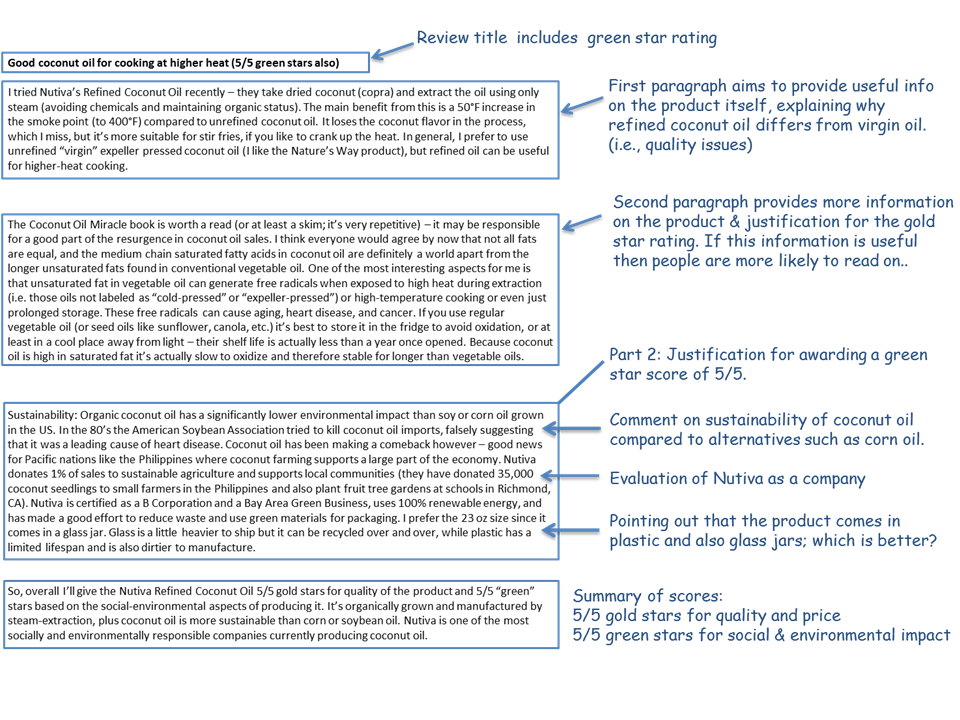 You can see the review as posted on Amazon here.
Nutiva: Social and Environmental Impact
You can read more about Nutiva’s own claims on social and environmental impact in their annual CSR (corporate social responsibility) report here.
As with all information posted on the company’s own website, you have to be wary of vague statements about how much they are working towards saving the planet and improving society. Even the very worst corporations on the planet will have statements to this effect. Look for hard facts. For example, from the Nutiva CSR report:
Energy Savings: We switched from 20% renewable energy from utility provider PG&E to 100% renewable energy via the Marin Clean Energy program.
Regarding sustainability of coconut oil versus corn or soy oil:
When coconuts trees get abundant rainfall, are organically grown, and are harvested with minimal mechanical inputs (like the coconuts we source), they have a much smaller environmental footprint than corn or soy harvested annually in the U.S. This is true even when taking into account shipping from Asia, since carbon emissions from marine container shipping are 32% to 55% more efficient than rail transportation according to a 2011 study by Herbert Engineering Corp.
Actually, in the second quote Nutiva claim that the coconuts they source have a smaller environmental footprint than corn or soy without backing this up with a reference. They provide a reference only for the transportation cost (emissions from shipping versus rail). Having looked into it a little, however, I do tend to agree that organic coconut palms (as long as they are not replacing sensitive habitats) are more sustainable than water, fertilizer, and pesticide intensive crops such as conventional corn and soy.
Other information from the report:
- Nutiva donate 1% of sales to support sustainable agriculture. They provide a list of their grant recipients in their csr report above.
- Nutiva is a also a certified B Corporation.
What is a certified B Corporation?
B Corp is a framework and certification system for companies wishing to benefit society (in addition to making a profit). To obtain a B Corporation certification, a company first completes a self-assessment under four categories: Governance, Workers, Community, and Environment. Companies that make the grade (scoring 80 out of 200 points) then undergo a review process and are required to provide supporting documentation before they are certified. Here are a couple of articles on the B Corp program:
Companies with Benefits – the New Yorker.
Their social and environmental performance must be regularly certified by a nonprofit called B Lab, much the way LEED buildings have to be certified by the U.S. Green Building Council.
Capitalism, but With a Little Heart – NY Times
Overall, the product doesn’t hit every single target – for example it isn’t Fair Trade certified, although Nutiva does support local farmers in various ways. But it does, in this reviewer’s opinion, rank in the top 10% in terms of social and environmental impact, which translates into 5/5 green stars. You may differ on your rating, and that’s the whole point – we need a consensus based on several opinions. Start reviewing now!
Update on ethical score for Nutiva
I wrote a review of Nutiva’s shortening on the GSP’s sister site, Ethical Bargains. I’ll add a few points from that post, below. Basically the company still deserves a high Green Stars rating as it continues to be a force for good. So please check out that post for more information on the social and environmental impact of Nutiva.
Based in Richmond, California, 80% of Nutiva’s workforce is represented by ethnic minorities and 50% of senior managers are women.
Nutiva’s shortening gets a high score from Fair for Life, covering labor conditions, trade practices, and some environmental issues.
Nutiva’s social impact includes support of local organizations like Planting Justice, which helps folk transition to life after prison though programs like urban farming and landscaping.
One of Nutiva’s other social contributions that I liked was the introduction of schoolyard orchards to all 28 public schools in Richmond, CA.
Nutiva contributes 1% of sales revenue to support regenerative agriculture systems. One example in 2019 is the development of climate-resilient, transparent supply chains for organic avocado oil in Ethiopia.
If you’d like to write a review that includes a Green Stars rating, please let me know! I’m happy to advise you and you can win a subscription to Ethical Consumer!
Discover more from The Green Stars Project
Subscribe to get the latest posts sent to your email.
 The Green Stars Project