

The following is an excerpt from my almost-complete book, Climactic: A Consumer’s Guide to Saving the Planet, for which I’m currently seeking a publisher.

I selected an excerpt from Chapter 6: Population Growth, as it seems timely. As you may have noticed, a cohort of politicians has risen to power who are all about xenophobia and protectionism. In the US, the movement marches on, even though most economists (conservatives, included) believe that protectionism is absurd.
A major root of all of this seems to be fear of scarcity: we have limited resources and a growing population so we’d better start competing harder. Establish even greater dominance (by rich white folk) by making life harder for everyone else.
So, without further ado…
In 1798, An Essay on the Principle of Population was published by Thomas Malthus, an English cleric and economist. Malthus theorized that the human population would grow more rapidly than the food supply that sustains it, and that the latter would eventually become a limiting factor. He discussed how population growth could be curbed by either reduced birth rates (birth control, delaying marriage until later in life) or higher mortality rates (famine, disease, and war). One chapter examined the “poor laws,” which had served in Great Britain since around 1600 to provide financial assistance to those who needed it. The idea took hold, even though it may not have been Malthus’s exact intention, that welfare programs would only fuel population growth.
Britain’s Poor Law Amendment Act was passed in 1834, and life became a lot harder for those who most needed assistance, as described by Charles Dickens a few years later in Oliver Twist. Instead of receiving a “free ride,” as many of the wealthy politicians saw it, the poor had to report to workhouses and perform pointless work, such as breaking rocks, in order to receive benefits. Researchers from the University of California, Davis, recently published evidence that the Poor Law Amendment Act provided no measurable social benefits and did not reduce population growth. The hardship that Britain’s poor endured for the remainder of the 19th century served no useful purpose.1
Malthus’s thesis has greatly influenced political and scientific thought over the last two centuries, but the interpretation that improvements in social welfare would fuel population growth has proven to be completely wrong. Analysis of regional fertility rates shows that population growth slows down as the standard of living improves.2 The populations of Europe and North America grew slowly (< 1%, annually) since the mid-1960s and are now static, overall, with declines in some countries. On the other hand, the population of sub-Saharan Africa has been growing at close to 3% annually and is expected to almost double between 2022 and 2050.
The fertility rates in Sub-Saharan Africa currently average around 4.6 births per woman, declining from a peak of almost 7 births per woman around 1980. All around the globe, fertility rates have been dropping over the last five decades, from a worldwide average of 5 births per woman in the 1970s to 2.3 births in 2021. The birthrate for maintaining a static human population is 2.1 births per woman, so the global population is still growing, albeit more slowly.
The UN Population Division (UNPD) predicts that the human population will climb from 8.0 billion (which we hit in late 2022) to reach a peak of around 10.4 billion people between 2080 and 2100. Just eight countries are projected to account for half of the population growth up to 2050: the Democratic Republic of the Congo, Egypt, Ethiopia, India, Nigeria, Pakistan, the Philippines, and Tanzania. It’s worth noting that the UNPD’s population forecast for 2100 has dropped quite significantly in recent years – from 11.2 billion in 2015 to 10.9 billion in 2019, and now 10.4 billion in 2022.3
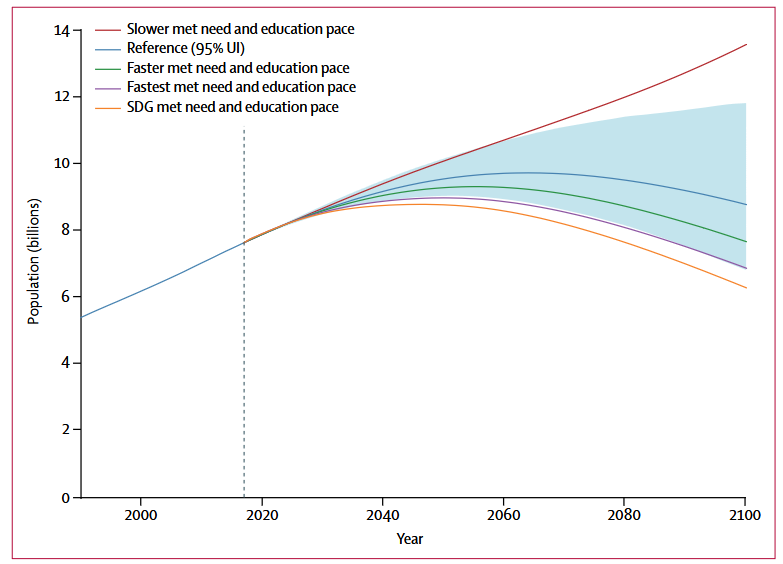
Researchers at the University of Washington (UW), funded by the Gates Foundation, suggest that these UNPD predictions are limited because they don’t allow for changes in policy or other drivers of fertility and mortality.4 Access to education, particularly for girls, and fulfilment of sexual health needs, such as contraceptives, are two key drivers of [lower] fertility rates. The UW researchers modeled population growth in a few scenarios that varied by how well these needs are met. In their reference scenario, based on current trends, the global population is projected to peak at 9.7 billion in 2064 and then decline to 8.8 billion by 2100. In an alternative scenario, the world meets targets for education and modern reproductive health (as described in the UN’s Sustainable Development Goals) by 2030 and the global population peaks below 9 billion and then declines to 6.3 billion by 2100.
Why is all of this so important? The most obvious reason is that a growing human population increases the burden we place on the planet – greenhouse gas emissions, changes in land use, pollution, etc. Second, it’s crucial to know that curbing population growth and improving living conditions in the Global South go hand in hand – two of the most pressing global issues can be tackled together.5 Third, the growing population is frequently used as the primary justification for industrial agriculture, so it’s good to have an idea of how much more the population is really likely to grow.6
I’m encouraged by the recent projections on population growth – both the downward trend of the UNPD predictions and the even lower projections by the UW researchers and others.7 Whether the population peaks in the 2060s or the 2080s, the important thing to note is that most models do predict that it will peak and then stabilize or drop within this century. The rapid growth phase is mostly behind us and it’s within our reach to avoid the worst scenarios predicted by Malthus (or not predicted, in the case of climate change).
By no means, however, are we out of the woods – the future very much depends on our collective and individual actions. In 2022, the UN Development Programme announced that the global Human Development Index value declined two years in a row for the first time.8 This was hopefully a temporary setback, largely due to the Covid-19 pandemic – a blip in a decades-long chart that shows a gradual in improvement in the Index, mirrored by the slowdown in population growth. Another threat is the rise of far-right regimes that cut support to organizations that aid human development in the Global South. The irony is that, like the 19th century proponents of the Poor Law Amendment Act, the far-right logic that withdrawing support for the poor will make them go away, or at least increase wealth for the already-wealthy, is deeply flawed.
It’s widely agreed upon that the best ways to limit population growth to manageable levels are human rights-based approaches. They include “investments in girls’ education, opportunities for women to join the work force, and family planning programs that include affordable access to all types of safe, effective contraception for men and women.”7 Curbing population growth while supporting human rights is clearly a win/win, unlike the Poor Law Amendment Act, which was a lose/lose situation for social welfare and population growth.
Notes:
- Welfare reform, 1834: Did the New Poor Law in England produce significant economic gains? (2018)
- United Nations Department of Economic and Social Affairs, Population Division. World Population Prospects 2022: Summary of Results. UN DESA/POP/2022/TR/NO. 3 (2022). An update, published in 2024, again revises the population downwards, to a peak of 10.3 billion in the 2080’s.
- World Population Prospects. United Nations Department of Economic and Social Affairs, Population Division. (2017 and 2015)
- Fertility, mortality, migration, and population scenarios for 195 countries and territories from 2017 to 2100: a forecasting analysis for the Global Burden of Disease Study. (2020)
- I’m using the term Global South here as it’s considered to be less judgmental than the term developing world or the outdated Third World.
- I attended the annual meeting of the American Society of Plant Biologists in 2014 (Portland, Oregon) – one of the largest meetings in the plant biology world. Robert Fraley, who was CTO at Monsanto at the time, delivered a keynote speech at the meeting. After opening his speech with an introduction reminiscent of a rock-star, he switched to a grave tone and announced that he had just flown in from a UN meeting in which the estimate for the global population in 2050 had increased to 11 billion. This became the cornerstone of his talk about Monsanto’s technologies and future plans.
- See a discussion on various population projections and their relative likelihood in: Population growth and climate change: Addressing the overlooked threat multiplier (2020).
- Human Development Report 2021-22: Uncertain Times, Unsettled Lives: Shaping our Future in a Transforming World. New York. United Nations Development Programme (UNDP), 2022.
This was an excerpt from my almost-complete book, Climactic: A Consumer’s Guide to Saving the Planet (Chapter 6: Population Growth). I’m seeking a publisher or agent for Climactic so please contact me if you’d like to receive a book proposal. Thank you!
Discover more from The Green Stars Project
Subscribe to get the latest posts sent to your email.
