

For last week’s post, I put together a graphic showing different kinds of butter, dairy and non-dairy, ranked from 0 to 5 Green Stars.* To follow up on that, here’s a graphic showing ethical scores for various sources of protein in our diets. This is a simplified, somewhat subjective picture, but I think it’s useful. I’ll follow it with some notes and disclaimers 😉
*The Green Stars scale represents social and environmental impact, as you probably know if you’ve been here before.
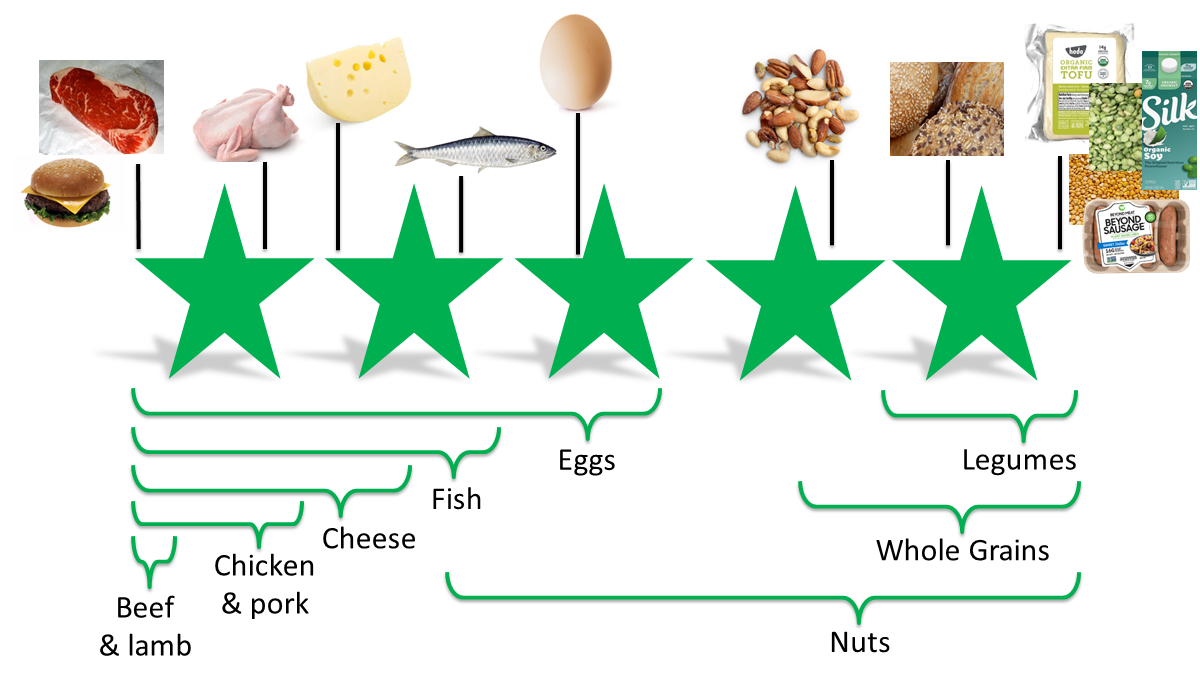
The scores pictured above are weighted averages – ranges that cover the majority of products sold in each category. Some categories include a fairly wide range of Green Stars scores. For example, certain kinds of seafood (small pelagic fish, wild salmonids, farmed bivalves) score much better than others (lobster, shrimp), especially when certified.
These rankings are based on years of evaluating products and keeping up with the science on the various impacts of food. For background, take a look at the environmental footprints of protein-rich foods, the nine planetary boundaries, the ethical issues with dairy, the social impact of meat, and posts on tofu (soy), Beyond Meat, Quorn, and bread.
For red meat – especially beef – the environmental impacts are so devastating (e.g., land use and greenhouse gas emissions) that it’s hard to even put it on the same scale as the other foods. Even more so when we consider how much carbon could be captured on land that’s currently used for beef production (reforestation, rewilding, etc.).
Choosing chicken or pork over beef is a big step up for meat-eaters. Even if the score changes from 0.1 Green Stars for beef to 1.0 Green Stars for chicken, it’s still a 10-fold improvement. And 10-fold is actually a good approximation of the difference between beef and chicken/pork across key environmental footprints.
Cheese has large environmental footprints – significantly larger than chicken and pork on metrics like land use and carbon footprint – so it ranks pretty low on the ethical scale. I even deliberated whether to rank cheese lower than chicken and pork. Sorry! I know that’s a bummer for cheese-lovers and vegetarians, including myself. But the more I learn about the footprints of cheese and reality of the dairy industry the more I’m avoiding cheese. To put a more positive spin on that, I eat cheese so rarely now that I really appreciate it!
Of the animal proteins that vegetarians consume, eggs are considerably better for the environment than cheese. Again, there’s a spectrum of ethical scores – clearly pasture-raised eggs are more humane than eggs from intensive farms. I’ll revisit eggs soon as progress is being made on addressing one of the main ethical issues in the industry.
I put whole grains on the list even though most people don’t think of them as a source of protein. But a good bread flour is around 12% protein – about half that of meat. Wheat protein forms the basis of the meat substitute seitan.
There are a few protein sources that I didn’t show on the list, including single cell protein (SCP). Quorn is the most common example of a SCP product – fungal biomass that’s grown in a fermenter, fed on wheat or other starchy plants. I’ve rated most Quorn products 4-5 Green Stars.
Legumes are among the best choices of dietary protein whether its lentils, beans, edamame, peanuts, dal, tofu, soy milk, or meat substitutes such as Beyond Meat. Legumes achieve high protein yields per hectare on low agricultural inputs while also helping to restore soil.
Making the graphic above has reminded me to not forget the big picture. We sometimes get caught up with details or distracted by misinformation campaigns and lose sight of the forest for the trees. The big picture in our food system is that we need to obtain as much of our protein as possible from items towards the right side of the scale above.
Choosing plant proteins such as legumes over beef ranks as the most important and accessible single action to support the planet and people. Specifically, to mitigate climate change, protect our remaining forests, preserve biodiversity, reduce water pollution, and ensure food security for a growing population.
Discover more from The Green Stars Project
Subscribe to get the latest posts sent to your email.

Thanks for sharing this info, James. Beef is definitely a no-no for the well-being of our planet. I cut beef from my diet in the 1990s on the advise of my doctor to reduce my high cholesterol. I’ve long ceased to crave the flavor. Cheese was the last thing I gave up before becoming 100 percent vegan.
LikeLiked by 2 people
Thanks Rosaliene – both for your comment and for taking action!
Cheese is a hard thing to cut for many people.
Hopefully knowing that eggs (and some fish) have much smaller environmental footprints than cheese will help with decision-making for those thinking to modify their diet for the planet.
I tried out a vegan butter recipe recently that I was very impressed with – will share in a few weeks after I work on some modifications 🙂 Now all we need is really good vegan cheese – what’s your go-to brand, if you do buy any?
J
LikeLiked by 2 people
A while back, I tried a vegan cheese (don’t recall it’s name), but my digestive system didn’t like it. Since then, I haven’t tried any other brand.
LikeLiked by 1 person
You’re pretty independent! What’s your favorite alternative to cheese that you make at home?
J
LikeLiked by 1 person
I have no alternative, James. I’ve just learned to enjoy my favorite dishes, such as the Brazilian Baiao de Dois–rice and black-eyed peas cooked with coconut milk–without the dices of cheese added when done for extra flavor. Coincidentally, I cooked it today. These days, I’ve replaced rice with cauliflower rice. My metabolism isn’t what it used to be 😀
LikeLiked by 1 person
thanks for this!
LikeLiked by 2 people
You’re welcome! Thanks for reading 🙂
LikeLiked by 2 people
My pleasure! 🌞
LikeLike
You’re welcome! Hope you found it helpful 🙂
James
LikeLiked by 1 person
Interesting! I had no idea a good bread flour has that much protein. I have to admit, I’m big on cheese, but almost never beef, and do go for a lot on the right side of the graphic. Always room to improve.
LikeLiked by 1 person
Thanks Steve!
Sounds like you’re doing pretty well.
The fact that cheese has such large environmental footprints is kind of new to me too so I’m adjusting also!
LikeLiked by 1 person
My pleasure, and thank you, too.
LikeLiked by 1 person
Hi, James, legumes are not only good for the health of the planet but also human health. I, too, am vegan. I say that I am an annoyingly healthy eater bc I am so careful about my food choices! ☀️
LikeLiked by 1 person
Hi Lisa,
True – legumes are great for health. The meat industry has tried hard to convince us otherwise (e.g., via Paleo diet nonsense) but we need to see through the BS.
Cheers!
James
LikeLiked by 1 person
Very interesting post especially since I’ve transitioned (for the most part) to being vegan. But I still break down and have that cheese on pizza and butter on popcorn. Might have to see if I can sneak a nut cream in for the cheese on pizza. I’ve managed to get this far…
LikeLiked by 1 person
Thanks for your comment, Mara!
Sounds like you’re doing pretty well.
Being mostly vegan for years is much better than being 100% vegan for months and then going back to meat.
Cheers!
James
LikeLike
Simple, very clear, and necessary ranking. Thank you.
LikeLiked by 1 person
Thank you for your comment, Dr. Stein!
J
LikeLike
Great post! You reminded me of all those “incredible edible egg” commercials. 🙂
LikeLiked by 1 person
Haha – that was before my time in the US, but I looked it up 🙂
Innocent times…. in some ways!
J
LikeLike