

I generally like Bill Gates. The Bill & Melinda Gates Foundation has previously funded malaria research that I was involved in. However, I think that his recent Gates Notes blog post on rethinking climate change is irrational – it simply doesn’t make sense when you boil it down.
Weirdly, I was about to write a blog post on my issue with Gates’s 2021 book, How to Avoid a Climate Disaster. I will return to that topic in a future post, but for now I’ll focus purely on his blog post: Three tough truths about climate (A new way to look at the problem). Before getting into why the post is irrational, let’s ponder why he wrote it.
Motivation behind Gates’s climate post
I think that it’s worth considering whether Gates would have written his blog post if Trump was not president. It fits in with a lot of rethinking (pivoting!) that’s going on among the billionaires in the US. I’m not saying that this is as much capitulation, for Gates, as it has been for others. It’s more like a negotiation.
At first I thought it was an attempt to reframe things: let’s think of climate change from the point of view of how it’ll impact human health. Sure! I was about ready to move on with my day but then realized that not what he was saying – he’s saying that we need to move funds away from climate and into poverty and health. As if there were only two things on the planet to fund. God forbid we might move money from defense to poverty and health!
He’s writing this shortly before the COP30 climate meeting in Brazil and also during a US Government budget shutdown. It comes across as one side of a deal: I’ll try to influence COP30 if you bring back funding to USAID and Gavi, the Global Alliance for Vaccines and Immunization. Just like the way a lot of 2025 has gone down – negotiations and deals.
Gates criticized the aid cuts. He said Gavi, a public-private partnership started by his philanthropic foundation that buys vaccines, will have 25% less money for the next five years compared to the past five years. – PBS
It’s also the possible that Gates is trying to pull a mastermind move, but I’ll get to that at the end.
Bill Gates on rethinking climate change
Gates’s new thesis, outlined in his blog post, is that poverty and health are bigger problems that climate change, which isn’t going to wipe us out. That’s it in a nutshell. Here are a few key quotes:
Although climate change will have serious consequences—particularly for people in the poorest countries—it will not lead to humanity’s demise.
That sentence is a bit chilling – especially if you replace “humanity’s demise” with “the demise of most wealthy people.” That may seem dramatic but it really is the implied statement: serious consequences for the poor but humanity will survive. He goes on to say,
This is a chance to refocus on the metric that should count even more than emissions and temperature change: improving lives.
He anticipates critics who will see his post as “a sneaky way of arguing that we shouldn’t take climate change seriously.” He states. “To be clear: Climate change is a very important problem.” He mentions that he offsets his own carbon footprint and invests in many projects and companies that are focused on climate change mitigation.
[Truth 1 from Bill Gates: Climate change is a serious problem but it will not be the end of civilization.]
But then he goes out of his way to convince us that everything’s going to be fine on the climate change front. He shows a chart delivering the message that climate change probably won’t be worse than a global temperature increase of 2.9°C. This claim is concerning for several reasons but is also a bit odd when you consider his next truth.
[Truth 2 from Bill Gates: temperature is not the best way to measure our progress on climate.]
It’s a pretty freaking good way of measuring how we’re doing! It’s a simple metric for keeping track of a complex situation. But of course, another good way of measuring progress is how much we are reducing greenhouse gas (GHG) emissions. The graph below from Our World in Data shows that, other the dip during the Covid-19 lockdown, GHG emissions have not started dropping yet.

Global GHG emissions from 1900 to 2023 (Graph from Our World in Data).
Climate Action Tracker, which Gates references for the temperature projection states that “Current policies presently in place around the world are projected to result in about 2.7°C.” Even that path requires that GHG emissions begin to drop right away. The IPCC projected that if we want to limit warming to 2°C, GHG emissions need to drop from the current 59 billion tonnes CO2-equivalents to around 20 billion tonnes by 2050.
It’s not even going to be easy to reach the least ambitious goals above. To take just one example, GHG emissions from the plastics industry are increasing and projected to reach as much as 7 billion tonnes CO2-equivalents by 2050 (a third of that IPCC target). I’ll return to that topic in an upcoming GSP post on compostable plastics.
Gates seems to be trying to establish 2.9°C as a new normal – forget about 1.5°C or 2.0°C, let’s all agree that 2.9°C will be good enough. It’s definitely not!! I’ll address that in the next section.
It also implies that we’ve got this – a lot of his blog post is focused on *solutions in progress. Don’t you sweat it, baby, we’re on target for this increase of 2.9°C, max, with everything that we’re doing. Um, not necessarily! If we all start to downplay climate then the doors are wide open to drill baby drill, etc.
*I’ll discuss his solutions in a future post on Gates’s 2021 book, How to Avoid a Climate Disaster.
Why is Gates’s new view on climate irrational?
Gates has been involved in many initiatives that address health in the Global South – that’s not in question. But that’s also why the blog post is so perplexing. Why would an expert in global health problems not acknowledge that climate change is actually the greatest threat to human health in the Global South?
First, let’s just take a look at some estimates. In his blog Bill Gates summarizes the situation as follows:
If you include the other major causes of death in poor countries – malaria, TB, HIV/AIDS, respiratory infections, and complications from childbirth—poverty-related health problems kill about 8 million people a year.
Here’s a quote from the last major set of reports on climate change from the IPCC (Sixth assessment, working group II):
Climate change will increase the number of deaths and the global burden of non-communicable and infectious diseases (high confidence). Over 9 million climate-related deaths per year are projected by the end of the century, under a high emissions scenario and accounting for population growth, economic development, and adaptation.
That’s about three times the death rate from Covid-19, which killed almost 6 million people in the first two years.
For sure, that’s just a projection – reality could be better or worse than that. But also consider that we have been improving solidly on major social metrics (like life expectancy), particularly since the 1990s. We have been making things better on the social side but at the expense of the environmental side.

In Not the End of the World, Ritchie makes the point that many social conditions have improved while the environment has suffered. The concept of sustainability entails providing society’s needs without depleting the planet’s resources (and prospects for future generations). We’ve been doing a better job on providing society’s needs, but at the price of the environment. So the realistic view is that the environmental side of the equation urgently needs to be addressed. – Should we listen to The New Optimists?
I think it’s also important to not get complacent by thinking that a 2.9°C increase in the global average temperature just means that our days will be three degrees Celsius (5.5°F) warmer. Extreme weather events that used to occur once every 50 years would happen roughly every second year and they will be more severe.
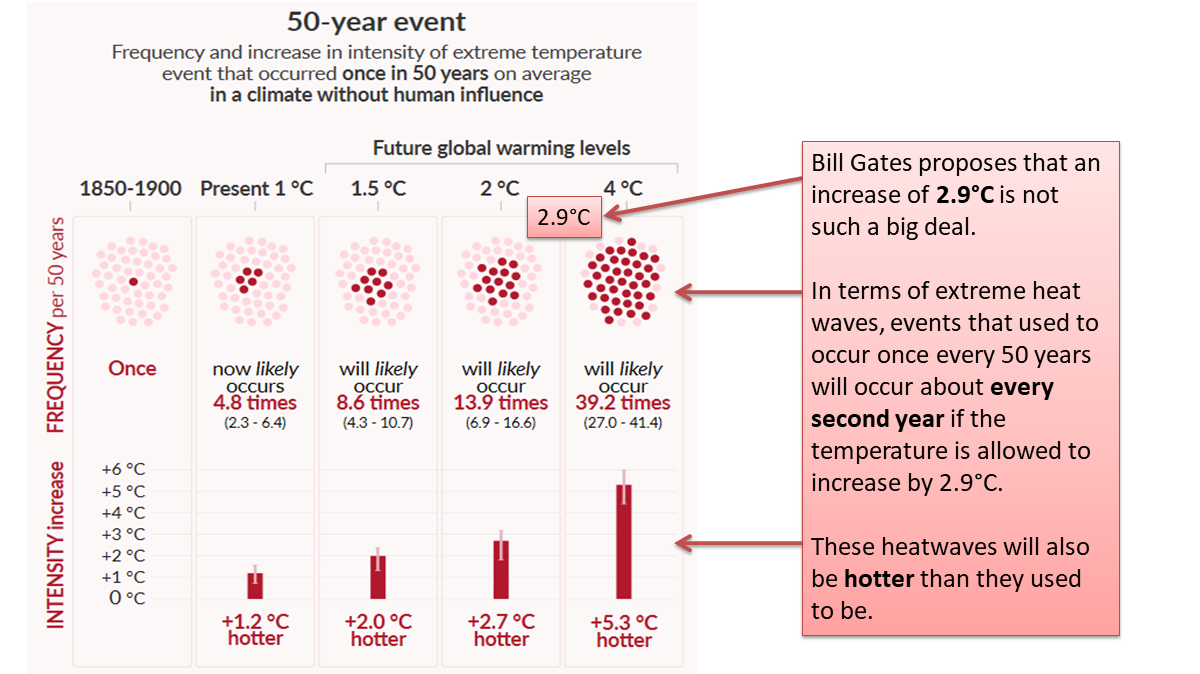
Extreme weather is not limited to short-term heatwaves but also includes longer-term droughts that can devastate food production.
Climate change is projected to put 8 million to 80 million people at risk of hunger in mid-century, concentrated in Sub-Saharan Africa, South Asia and Central America (high confidence). – IPCC
Between 1970 to 2019, 7% of all disaster events worldwide were drought related; yet, they contributed to 34% of disaster-related deaths, mostly in Africa. – IPCC
I think Gates knows most of this – so why is he pushing for this reduction in funding for climate change?
What if I told you I’m a mastermind?
Here’s what I thought Gates’s third truth was going to be (/should have been):
[Climate change is likely the biggest threat to health and security in the Global South.]
Instead he wrote this:
[Truth 3: Health and prosperity are the best defense against climate change.]
So it sounds like a switch in emphasis from climate change mitigation (reducing the problem) to climate adaptation (defending against it).
But, initiatives that bring people out of poverty also help mitigate climate change. This is a fairly common theme here on the GSP – for example, see this post on how our choice of chocolate impacts poverty and population growth or this recent analysis on the efficacy of fair trade.
Fair trade programs, although not perfect, have been repeatedly demonstrated to improve income and quality of life in the Global South. – Should you support fair trade?
Beyond Good’s CEO, Tim McCollum, says that the consequences of their farmers earning five to six times more than cocoa farmers in West Africa have been remarkable. Not only are they more likely to be able to send their children to school, but farmers also began practicing regenerative farming because they had the money to invest in it. It’s pretty hard to think about the environment when you’re on the poverty line, but once they escape poverty and are able to look after their families, the farmers often turn to thinking about nature. – Review of Beyond Good chocolate on Ethical Bargains.
Gates doesn’t discuss the corporate exploitation of the Global South or how our actions as consumers are central to reducing poverty. But the programs that he’s invested in do address symptoms of poverty (even if they don’t address the root causes) and that’s an important part of the equation too.
So, is this a mastermind move, where Gates is pretending to care less about climate change while suggesting actions that will actually help mitigate it? There are two main reasons to doubt this, or at least to believe that his thinking is clouded by the defunding of USAID and Gavi:
1. Why would the money for healthcare and poverty specifically have to come at the expense of climate funding? There are plenty of other ways to generate money.
Jeffrey Sachs, director of the Center for Sustainable Development at Columbia University, called the memo “pointless, vague, unhelpful and confusing.” “There is no reason to pit poverty reduction versus climate transformation. Both are utterly feasible, and readily so, if the Big Oil lobby is brought under control,” he wrote in an email. – PBS
2. He said it himself near the beginning of the blog post. Climate change is going to disproportionately affect poor people. If we want to secure a better future for the Global South, we need to figure out climate change.
“There is no greater threat to developing nations than the climate crisis,” said Michael Mann, Director, Penn Center for Science, Sustainability & the Media. “He’s got this all backwards.” – CNN
The Magnus Effect
We have the tendency to trust that smart people always get things right. In modern chess this is sometimes called The Magnus Effect – players facing Magnus Carlsen (widely agreed as the greatest of all time) sometimes miss his errors, assuming that his logic is correct.
The same applies to Bill Gates’s blog post. The only difference here is that Gates’s departure from logic is quite likely deliberate, in an attempt to make a deal.
I think it’s a bad deal, and I urge the participants at COP30 to ignore Gates’s rhetoric. Of course tackling poverty and global health problems is important, but this is not an either/or situation.
Discover more from The Green Stars Project
Subscribe to get the latest posts sent to your email.
 The Green Stars Project
Thank you for this analysis. Because somewhere in me, for reasons I can’t completely explain, I often feel the need to defend him without all the facts. Part of it is because I recoil at ridiculous conspiracy theories targeted at him.
But the power these wealthy individuals wield should always be scrutinized. I can’t do it well. Thankfully, you can. x
LikeLiked by 1 person
Thank you Frances 🙂
Not everyone has a week to research it and prepare a response.
I understand your instincts to defend him sometimes. He gets some things right, of course, but he’s not an expert on climate.
I’m re-reading his 2021 book now and in the introduction Gates admits that’s a software guy, not a climate expert, and actually didn’t really grasp the concept and gravity of climate change until late 2006!
LikeLike
James, I was also taken aback by Bill Gates’ latest position on our global climate disaster. Thanks for breaking it down.
LikeLiked by 1 person
Thanks Rosaliene!
Did you see the NY Times opinion piece on it yesterday? I’ll post a comment on it below.
J
LikeLiked by 1 person
No, I haven’t seen it.
LikeLiked by 1 person
It’s a little disturbing that the NY Times published an opinion piece on Gates’s post on Sunday without acknowledging that it was written by the recipient of a Gates Foundation scholarship.
The article is titled Bill Gates Has a Point, which implies that it supports his thesis. However, it only agrees with the idea that climate change will disproportionately affect people in the Global South. People already agree with this – it’s not controversial.
The actual content of the opinion piece makes no comment on Gates downplaying the gravity of climate change. Does a casual reader of the article notice this? I’d doubt it. The message that Gates is really delivering is that we can ease off on funding for climate change (we’ve got this) and the message of the headline of the NYT article is that Gates is correct. I feel that everyone’s being played right now.
LikeLike
Another defector from the truth. So sad.
LikeLiked by 1 person