

When you see that a company is a certified B Corporation, should you assume that the product is ethical? (When I say ethical, I mean does it rate at least 3 out of 5 Green Stars for social and environmental impact.) The short answer is that most B Corp certified companies qualify as better than average on the ethical scale but not all. We’ll take a look at this in a moment but first let’s take a quick at B Corp and the more general concept of benefit corporations.
What is a certified B Corporation?
Basically, certification by B Corporation indicates that the company is doing better than average on at least some social and environmental metrics. Here’s a definition from the certifying body, known as B Lab.
A Certified B Corporation (a.k.a. B Corporation, Certified B Corp, or B Corp) is a for-profit legal entity that has obtained certification from the nonprofit B Lab. B Corp Certification is a designation that a business is meeting high standards of verified performance, accountability, and transparency on factors from employee benefits and charitable giving to supply chain practices and sustainability. This new type of corporation—the B Corp—is purpose-driven and creates “benefit for all” stakeholders, not just shareholders. – B Lab (bold emphasis mine)
So a company can achieve a B Corp certification based on an evaluation by the third-party nonprofit, B Lab, and payment of a fee. The concept overlaps with a legally-defined category of corporation known in the US as a benefit corporation.
What is a benefit corporation?
A benefit corporation is a for-profit business that also addresses social, economic, and/or environmental needs. It’s a response to the concept that a conventional corporation is legally bound to place shareholder profits above any benefit to customers or the environment.
This legal precedent was set just over a century ago, in the 1919 Dodge v. Ford court case. Henry Ford had wanted to offer Ford cars at a reasonably low price while offering employees good benefits (and making a modest profit for the company) but the court ruled against him. Since then, shareholder-owned corporations have been obliged to place profits (shareholder value) before everything else.
Flash forward almost a century and now, in a growing number of countries, there is a legal structure that allows companies to avoid this situation. Benefit corporations came about in 2010 in the US (Maryland, initially), 2005 in the UK (where they are called Community Interest Companies – CICs), 2015 in Italy (Società Benefit) and 2018 in Canada (only in British Columbia, so far).
You can consult this list on Wikipedia for a list of some benefit corporations – you’ll see some familiar names like Patagonia, Bluesky Social, Ben & Jerry’s, Ecosia, Allbirds, Alter Eco, Seventh Generation, and Tofurky.
There’s a fair amount of overlap between a certified B Corp and a benefit corporation. In fact, a company that has been certified as a B Corp is expected to incorporate as a benefit corporation before the certification is up for renewal.
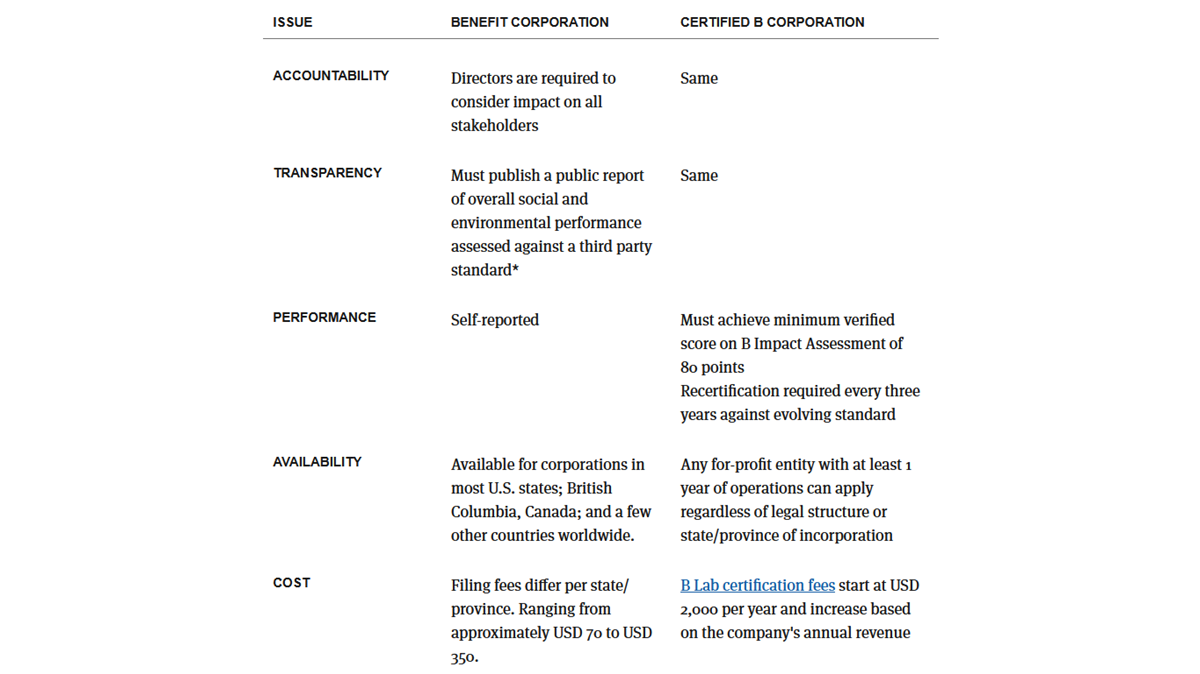
So there’s no argument that the benefit corporation has been a good development – and the B Corporation concept too. My main question here is whether we should see the B Corp logo as a reliable indicator of an ethical product. Maybe the best way to do this is to take a look at one of the weakest cases: the certification of Nespresso as a B Corp.
Nespresso’s certification as a B Corp
A concern with any third-party certification is that it will sell out to some extent. Certification programs benefit by having more members, of course, so it can be tempting for them to lower standards to attract big players. Fair trade USA split from Fairtrade International to expand membership criteria beyond cooperatives, for example. It’s always a balancing act between maintaining standards and expanding to include new members.
B Corp risked ruining its good reputation by certifying Nespresso, the coffee pod company owned by Nestlé, in 2022. In response to the certification, Dr. Bronner’s, the soap maker that had been certified as a B Corp for a decade, threatened to leave the organization. David Bronner, CEO of Dr. Bronner’s said that he would rejoin tomorrow if B Corp introduced stricter rules for multinational corporations.
UK-based pet food company Scrumbles also quit B Corp in protest, donating cash to charity instead of paying the membership fee. Scotland-based Green Lyon coffee roasters published a well-reasoned blog post, protesting the certification of Nespresso. They pointed out that most aluminium pods are not recycled (a shame since aluminium recycling is normally very efficient) and that Nespresso’s investments in farming communities (a program named Reviving Origins) are small beans compared to advertising budgets and sales figures:
Reviving Origins will reportedly cost Nespresso US$10 million over a five-year period, while it paid George Clooney a reported US$40 million to be the face of the company. Meanwhile Nespresso had reported sales of $7 billion in 2021. – Green Lyon Coffee Roasters.

An open letter signed by several certified B Corporations called for stricter regulations and B Lab responded by asking for input on drafting new rules.
I’m actually fairly heartened by this debate. The existing B Corp member companies are very much invested in the program maintaining high standards. The fact that the certification of Nespresso by B Corp was perceived as a misstep is a good indication that that the program had been doing a pretty good job up to that point. Hopefully B Corp (B Lab) will learn from the experience.
So how should we consider B Corp certification as a consumer seeking ethical products?
Does a B Corp certification indicate that a company is ethical?
When I see that a company is a certified B Corp, I take it as a good sign but not the whole story. It’s a piece of the picture, to be taken into account along with other factors. I’ll take a few examples below – Danone, a dairy-focused multinational, and Patagonia, the clothing company known for transparency and efforts towards sustainability.
When writing a Green Stars review and considering a company’s B Corp certification, I’ll usually take the following factors into account.
What is the company’s B Corp impact score?
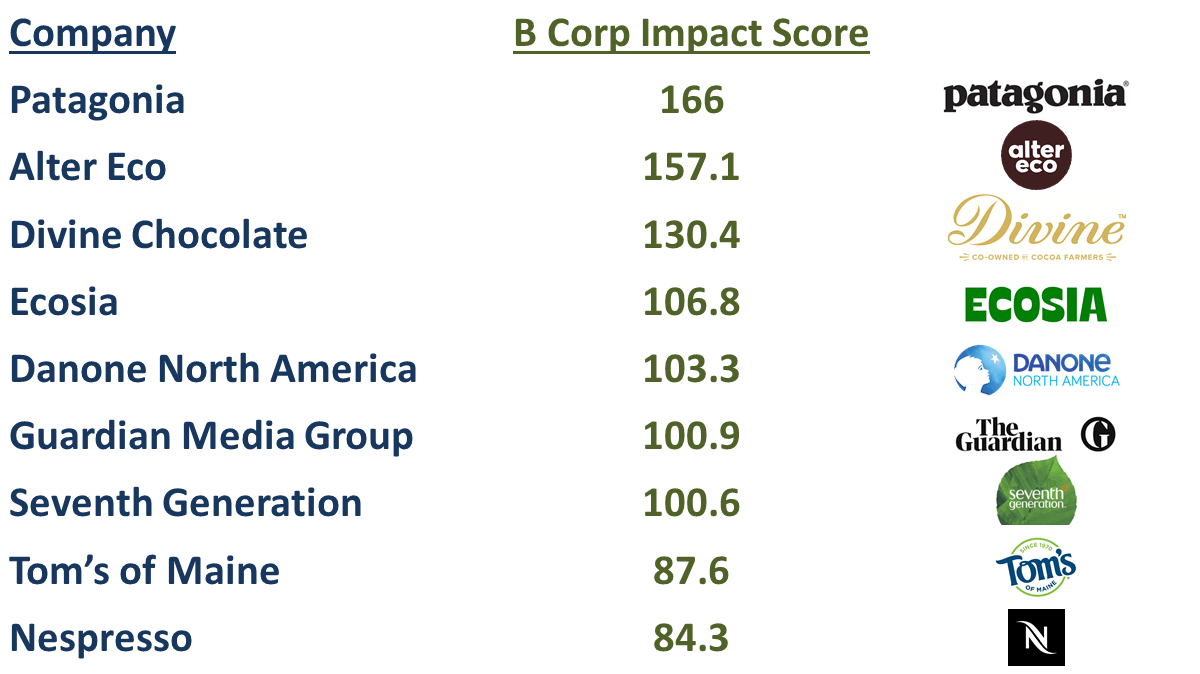
Each company that applies for B Corp certification is evaluated according to various social and environmental metrics, resulting in an Impact Score. The average impact score for “ordinary businesses” is around 50, according to B Corp, while the minimum score for certification is 80. You can search for a company by name on the B Corp site (or browse by industry group) and see its impact score and a breakdown of the score by various social and environmental metrics.
Danone North America has a current score of 103 while Patagonia’s score is 166. Patagonia is up there with one of the highest scores – the maximum score is 200 but I think there are some bonus points available as Dr. Bronner’s had a score of 207. When a company like Nespresso just barely qualifies for certification – it received a score of 84 – this should be taken into account.
Is the score increasing over time?
Danone North America’s original score was 85 when initially certified in 2018 while Patagonia’s was 107 when first certified back in 2011. Both scores have increased over time – Danone’s by around 21% over 7 years, and Patagonia’s by 55% over 14 years.
What does the company sell?
The presence of a B Corp logo on packaging tells us that the company has qualified for certification based on an evaluation of general company operations. But we really have to combine this information with the more concrete substance of what the company is actually selling, and what the alternatives are.
I don’t think anyone could argue that Nespresso coffee pods are a good alternative to Fairtrade/organic/bird-friendly coffee beans (maybe in compostable packaging) from a mission-driven company. Nespresso has an in-house ethical sourcing program (AAA Sustainable Quality) that’s misleading to consumers as it comes with a logo that looks like a third-party certification. This program basically just describes Nespresso’s own policies and is not equivalent to a respected third-party certification such as organic or Fairtrade International.
Then there’s a company like Danone that makes conventional dairy-based products but also owns vegan brands. I’ve reviewed two of these vegan brands on ethical bargains – So Delicious and Silk – and they all scored higher than average on the Green Stars scale. Silk organic heavy cream – 4/5 Green Stars; Silk organic soy milk – 4.5 Green Stars. So Delicious vegan ice cream – 4/5 Green Stars, So Delicious vegan cheese – 3.5 Green Stars.
Naturally, I wouldn’t rate any of Danone’s dairy products that highly because of the animal welfare and environmental impacts of intensive dairies. So the fact that Danone is a certified B Corp is useful general information about the company, but its products range from very poor to very good on the ethical scale.
Conclusion: Should we trust B Corp?
Trust in and respect for B Corporation took a hit when Nespresso was deemed worthy of certification. Having said that, the organization was responsive to criticism and time will tell whether this was just a blip in what was otherwise a pretty good track record.
I consider a B Corp certification to be a good thing, but with a couple of caveats. It’s a good idea to check the company’s Impact Score and certainly to take a step back and consider what exactly the company is selling. As they say, you can’t make a silk purse from a sow’s ear!
Discover more from The Green Stars Project
Subscribe to get the latest posts sent to your email.

Thanks for the info, James.
LikeLike