

Lately, I’ve been reading books examining how life has improved in many ways over the last two millennia, and especially over the last two centuries. These improvements include large reductions in poverty and violence, plus increases in longevity and human health. And actually the most progress has been made in the last few decades.
I recently learned that these writers and thinkers have been collectively termed the New Optimists. A July 2017 Guardian article is credited with bringing this term into common usage and provides a useful introduction into the pros and cons of this way of thinking. Not surprisingly for an article written in July 2017, it examines this optimism in the light of the big 2016 election results: Brexit and Trump.
Well thankfully now, in Sept 2025, that’s all behind us. Oh wait…
Coincidentally I wanted to take a quick look at this body of work by the New Optimists in the light of our current situation, particularly here in the US. Here’s a brief rundown on some examples of work that uses data to show that life has generally been getting better over time.
Hans Rosling – human health & poverty
Dr. Hans Rosling was a Swedish statistician and doctor with a PhD in public health. He dealt with several personal medical issues (testicular cancer and hepatitis C) and died before his time of pancreatic cancer. He’s most famous for his entertaining high-energy talks, even showcasing his talent as a sword-swallower at the end of this talk on poverty.
Dr. Rosling’s book, Factfulness (2018), was published a year after his death and Rosling’s son and daughter-in-law, Ola and Anna, continue to manage Gapminder, a global data website that they founded together. The second half of this quote from Gapminder is worth noting:
This overly dramatic, pessimistic worldview not only erodes hope among younger generations but also shapes the global political agenda in harmful ways. – Gapminder.
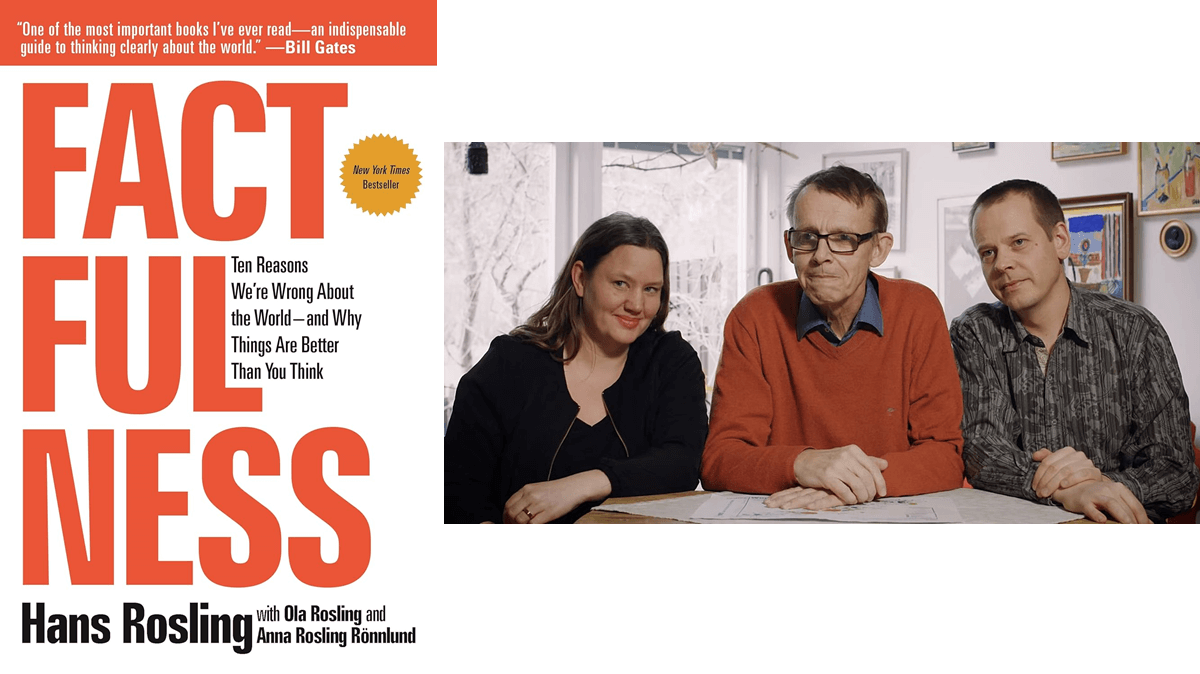
In the introduction to my own book-in-progress, I recommended watching a Dr. Rosling talk, or reading Factfulness, as an antidote to defeatism:
Some of us, especially if significantly older than Greta Thunberg, may suffer a little bit from defeatism: We’re basically screwed so I may as well enjoy my life while I can. (Greta’s fury at those who squander her future is totally justified.) It’s crucial to avoid this defeatist mindset and to remember that, on several fronts, a lot has improved in human society over time. … As Dr. Rosling pointed out, many things such as sanitation and education in the Global South are generally improving. – Climactic.
Here’s a video of Hans in action:
Steven Pinker – violence and quality of life
I’m not really a fan of Steven Pinker, but data is data and two of his books share lots of useful information on the human condition. In The Better Angels of Our Nature (2011), Pinker shows how violence has declined over our history. Interestingly, the book was favorably reviewed in the Guardian by David Runciman (former professor of politics at Cambridge) who was later featured in that 2017 Guardian article as a critic of the New Optimists.
Runciman isn’t a critic of optimism, exactly, but more of complacency (or over-confidence in democracy) which can lead to people making decisions like voting for Trump or Brexit, just to shake things up a little bit. He published a book on this topic, The Confidence Trap, two years after Pinker’s Better Angels.
In any case, Runciman’s positive review of Pinker’s book acknowledges that it’s good to be aware of real-world facts such as the decline in violence (as long as we avoid complacency). A realistic view of the world encourages people to make more grounded and rational voting decisions.
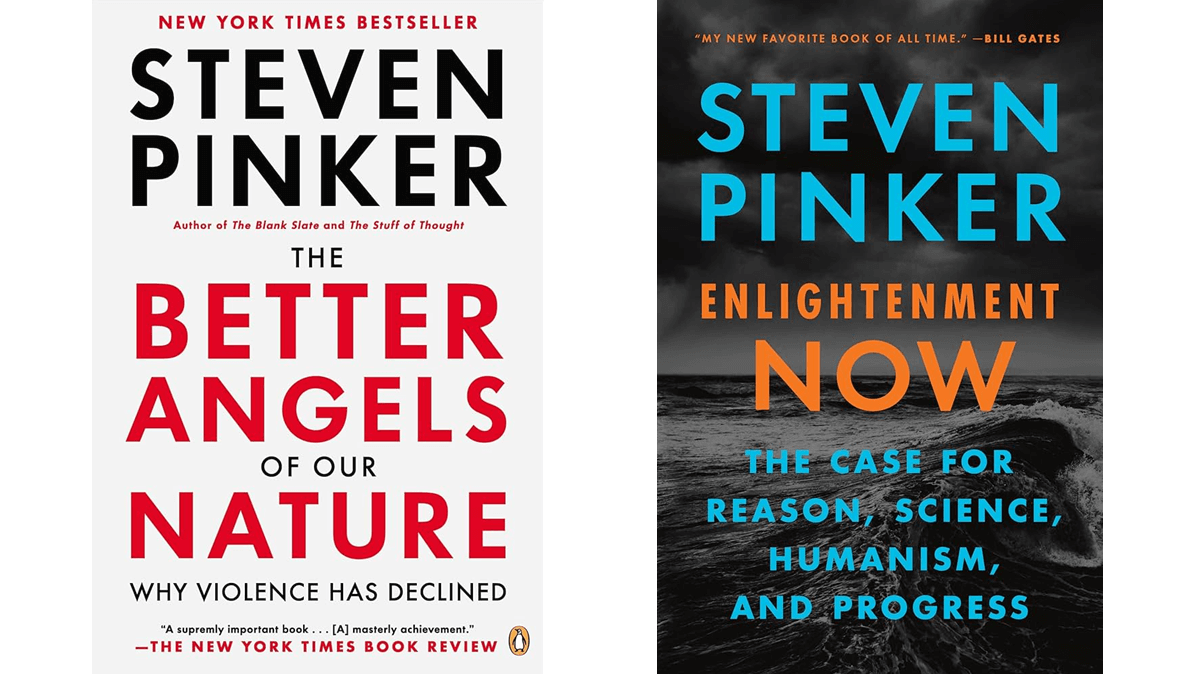
Pinker’s second book on the topic of things getting better is Enlightenment Now (2021). Here’s Wikipedia’s summary of the Enlightenment (AKA, the Age of Reason) which took off in the 18th century:
Characterized by an emphasis on reason, empirical evidence, and scientific method, the Enlightenment promoted ideals of individual liberty, religious tolerance, progress, and natural rights. Its thinkers advocated for constitutional government, the separation of church and state, and the application of rational principles to social and political reform.
Pinker argues that we need to embrace these values now, especially in governments.
Who could be against reason, science, humanism, or progress? They define the missions of all the institutions of modernity – schools, hospitals, charities, news agencies, democratic governments, international organizations. Do these ideals really need a defense? They absolutely do.
Pinker goes on to discuss populist political movements:
They are tribalist rather than cosmopolitan, authoritarian rather than democratic, contemptuous of experts rather than respectful of knowledge, and nostalgic for an idyllic past rather than hopeful for a better future.
He quotes a New York Times article reflecting on the media’s role in the 2016 US election:
Trump was the beneficiary of a belief – near universal in American journalism – that “serious news” can essentially be defined as “what’s going wrong.” One consequence is that many Americans today have difficulty imagining, valuing or even believing in the promise of incremental system change, which leads to a greater appetite for revolutionary, smash-the-machine change
Most of Enlightenment Now focuses on data showing how much incremental system change we have made – especially over the last two centuries.
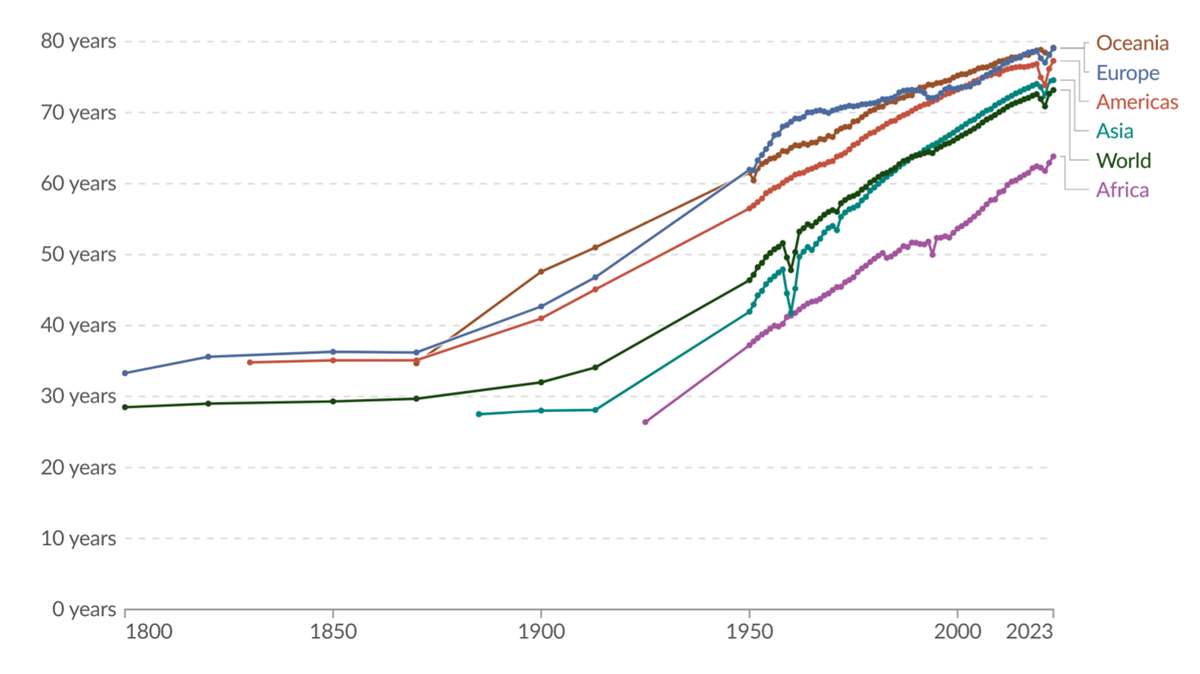
A fair amount of Pinker’s data comes from the respected website for understanding the state of things in the world: Our World in Data. Its founder, Max Roser, has been cited as a New Optimist, but actually the site just showcases objective data, positive or negative.
Max Roser – Our World in Data
Professor Max Roser (University of Oxford) established Our World in Data, a non-profit that aims to publish the best available scientific data on a range of topics. I’ll refer you to this video where Max explains this himself:
You’re probably already familiar with the website so I’ll just feature a quick example of its data, on extreme poverty:

Another way to view the data above is that in 1850, 87% of the world’s population lived in extreme poverty but by 2015 that number had dropped to 15%.
Two remarkable things about the data above: the reduction in extreme poverty occurred in a short timeframe (starting in the 1990s) and it took place in spite of the massive increase in the world’s population!
Hannah Ritchie – the environment
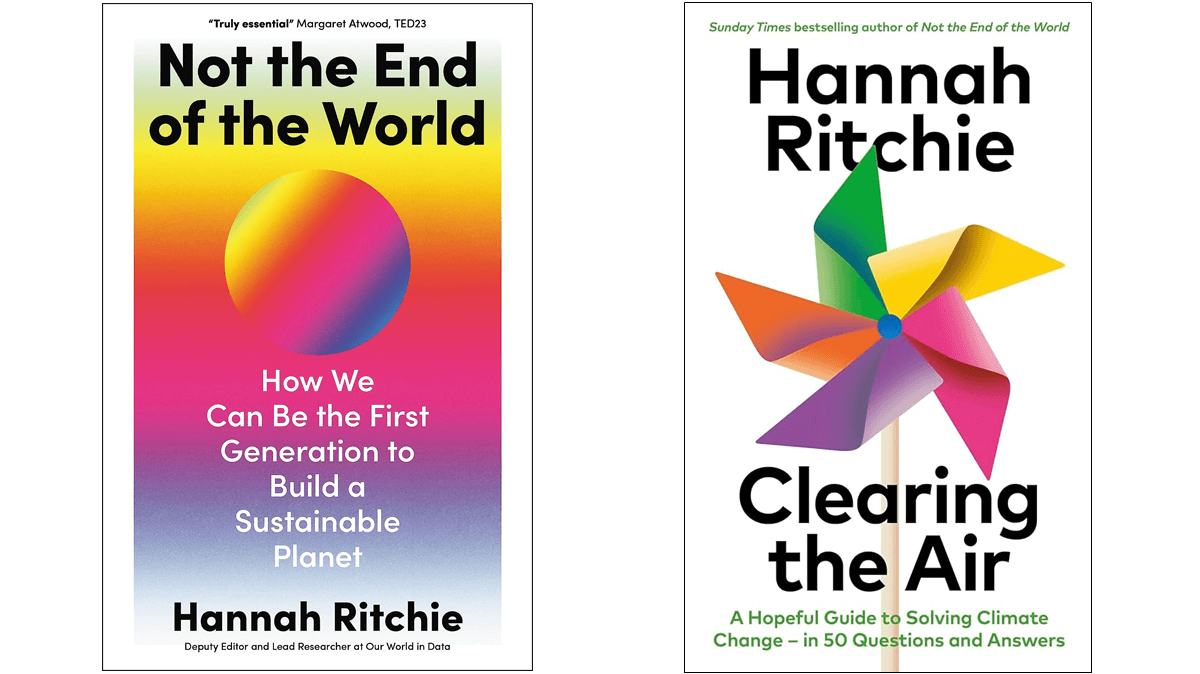
Hannah Ritchie is another academic at the University of Oxford – but she’s from Scotland so we’ll give her a pass 😉 She’s also Deputy Editor at Our World in Data, and is credited for her excellent coverage of Covid-19 data on that site. Her first book, published last year, is titled Not the End of the World, and her second (Cleaning the Air) is about to come out.
I have some thoughts on Dr. Ritchie’s book but they overlap with my thoughts on Bill Gates’s book How to Avoid a Climate Disaster (2021), which can also considered as an optimistic take on our problems. So I’m going to save those thoughts for a future post and keep this one to a reasonable length 🙂 For now, I just want to share this quote from Ritchie’s Not the End of the World:
I often feel embarrassed to admit that I’m an optimist. I imagine it knocks me down a peg or two in people’s estimations. But the world desperately needs more optimism. The problem is that people mistake optimism for ‘blind optimism,’ the unfounded faith that things will just get better. Blind optimism is really dumb. And dangerous. If we sit back and do nothing, things will not turn out fine. That’s not the kind of optimism that I’m talking about.
What we need is realism
I really enjoyed the first few chapters of Pinker’s Enlightenment Now and was ready to recommend it. Then, about ten chapters in, I started to get tired of the snarky tone and a perspective that seemed to deviate more and more from reality. Pinker set out to write a book with the theme of Everything’s Fine but then increasingly struggled to make the data fit his thesis – particularly in chapters on inequality and the environment. To his credit, he did admit that things are not exactly fine in these areas, but it’s too easy to forget these disclaimers (like the quote from Ritchie’s book, above) and come away with a warm fuzzy feeling that we’re all OK.
In Not the End of the World, Ritchie makes the point that many social conditions have improved while the environment has suffered. The concept of sustainability entails providing society’s needs without depleting the planet’s resources (and prospects for future generations). We’ve been doing a better job on providing society’s needs, but at the price of the environment. So the realistic view is that the environmental side of the equation urgently needs to be addressed.
As Ritchie points out, we need to be careful to avoid blind optimism. It’s not as bad as blind pessimism (defeatism or despair) but the ideal is to have an outlook that’s based firmly on reality. In other words, we should embrace neither optimism nor pessimism but a neutral realism.
Having said that, I think most of us could do with a dose of positive news at the moment – a counterweight to the bad news that the media bombards us with, every day. But we do need to keep it real by looking at both our successes and challenges together. For example, it’s good to know that we’ve dealt with one of the nine planetary boundaries – the ozone layer – pretty successfully. This should give us some confidence that we are capable of addressing the six boundaries that are currently in the danger zone.
Just as important, we need to maintain a long view rather than getting caught up in short-term events. Most of us have only a dim view of the big picture, as Hans Rosling went out of his way to demonstrate. It’s well known that the media focuses on the negative – I can’t tell you how many times I’ve come across the news maxim, if it bleeds it leads, while researching this post! But, of course, the media also focuses very much on the short-term – it’s the news, not the olds, after all 🙂
A long-term and realistic viewpoint shows us that many aspects of life on Earth have improved and that we don’t need to destroy the system. They also help us avoid nonsensical viewpoints – for example that the risks of vaccines outweigh the benefits or, on a lighter note, that the paleo diet makes any sense!
Case study: Longevity and the Paleo Diet
One dataset is showcased on pretty much every New Optimist book or website: graphs showing that the human lifespan has radically increased over the last century, across the globe. That’s pretty much the granddaddy of all stats on whether things are getting better or worse. Thanks to developments in microbiology, hygiene and medicine, child mortality is way down and longevity is up.
And yet, millions of people buy into the Paleo Diet, a completely fabricated diet, designed in reverence of those healthy Paleolithic people. People who very rarely made it into their 40s…
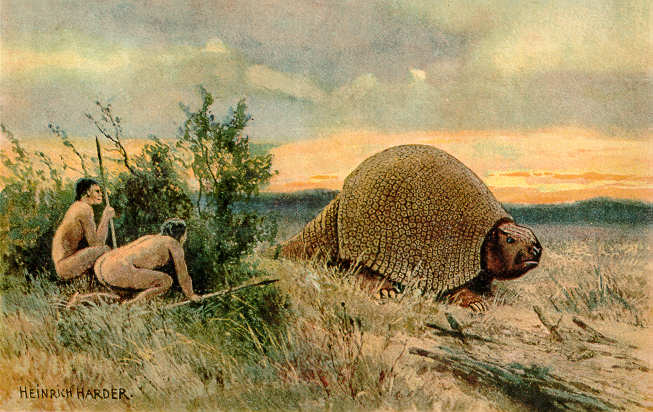
It may sound like harmless fun, but most of these ideas have agendas. The Paleo Diet is basically a marketing machine for meat with very little scientific credibility.
People often choose to buy into these ideas that suit their agenda – in this case, reducing the cognitive dissonance of a meat-heavy diet. That’s why Paleo has worked so well as a meat marketing tactic: it’s preferable to romanticize the good old days of the Paleolithic period than to face the truth. Make America Paleo Again!
Discover more from The Green Stars Project
Subscribe to get the latest posts sent to your email.
 The Green Stars Project

Found this helpful – extremely – and will go deeper into Rosling, Ritchie, and Roser. Hmmm – the letter R – an advanced episode of Sesame Street?
This post is good for those of us feeling the weight of things. Thank you!
Hope you’re well. xx
LikeLiked by 1 person
Ha ha – yes, and then Pinker. One of these kids is not like the others. (But actually he’s pretty similar – just a little overly optimistic about some things).
Glad you found it helpful, Frances!
I’m doing okay thanks – hope you are too!
J
LikeLike
Such an inspiring perspective! 🌍 It’s uplifting to be reminded of the progress humanity has made, even when challenges still remain.
LikeLiked by 1 person
Thanks Safia.
Yes – important to maintain perspective!
LikeLike
I didn’t know you were working on a book, too! How interesting. How far along are you with it? Also, cheers to you for emphasizing the importance of the longview. In a world of goldfish memory, that’s a much needed reminder.
LikeLiked by 1 person
Thanks Andrea! Yes, I have about 2.5 chapters to go (17 total).
…and then some revision!
How about yours?
LikeLiked by 1 person
Niiiice! Well….mine has grown legs. LOL! What started as The Scotland Book has now spread out to the prequel – (South Carolina) – and whatever you call a 3rd book (Atlanta). (You’re the first to hear this, so…ya know. Keep it a secret lol). Each one has 23 chapters. So SC and Scotland are written. Still more editing to be done on both. The 3rd is being mapped. I may scrap it all together, who knows. This is the kind of thing that happens when you’ve marinated on a project for a whole decade lol. So – we’ll see what happens with this.
LikeLiked by 1 person
It’s an honor to be the first to hear you plan, Andrea 🙂
As long as it’s compelling for you (and maybe enjoyable / instructive) then don’t worry yet about what happens once it’s done!
J
LikeLike