
Certification by the Forest Stewardship Council (FSC) is designed to assure consumers that forestry-related products are produced with minimal environmental damage. This post will examine whether or not FSC certification counts for much, based on peer-reviewed publications.
Most often, the first level of an ethical purchasing decision is the material involved – for example, wood versus plastic. In principle, a wooden chopping board is a better choice than a plastic one – wood’s carbon comes from atmospheric CO2, via photosynthesis, while plastic’s carbon comes from non-renewable petrochemicals.
But then the second level of the decision is to try to get some idea of whether the wood comes from a responsibly-managed forest. That’s usually when third-party certifications come in – they provide a way for customers to quickly see if a product meets certain criteria. The problem here is that most of us are unsure about whether a particular certification is trustworthy. I count myself here too – I don’t really know how much stock to put in a particular certification until I’ve researched it.
In two recent posts, I’ve examined the literature to get an idea of whether Fairtrade International and the Rainforest Alliance certifications are worth seeking out. In this post, I’ll examine the most respected data to get an idea on whether certification by the Forest Stewardship Council (FSC) is worthy of your trust and support.

Can you trust the FSC?
I’ll get into the details below but here’s a little summary for those with little time. Before starting research for this post, I had the idea that FSC certification was trustworthy. Then, the first few articles I read online shook that trust a bit. However, as I read more, I realized that the articles were far from balanced and that the most recent high-quality research indicates that the FSC is worth supporting.
This is unfortunately how things go with many topics – our assessment may not be accurate depending on how much research we’ve done. One poorly-researched (or intentionally misleading) article that ranks highly on Google is often all it takes to sway opinions. And since we live in the era of fake news and agenda-driven (social) media campaigns, we have to be extra careful. I’ll usually keep digging into a topic until fairly confident in my assessment. At the end of this article I’ll rank FSC alongside the other two that I’ve evaluated recently: Fairtrade International and the Rainforest Alliance. So you’re welcome to skim to the end (and glance at the figures) if you don’t need much convincing.
Criticism of the FSC
An article on Yale Environment 360, published in 2018, is still a top hit from internet searches on the FSC. Many people would see the title (Greenwashed Timber: How Sustainable Forest Certification Has Failed) and figure that this is case closed considering that it came out of Yale. However, the author (Richard Conniff) studied English at Yale and has no scientific credentials. He has written for many respected media orgs (Time, National Geographic, etc.) but in this case the article has several scientific and logical flaws.
I won’t spend too much time getting on these flaws as the comments at the end of the article capture many of them and there’s also a rebuttal online. But here’s a quote from the Yale360 article:
A 2016 meta-analysis of scientific studies found that FSC certification in the tropics has reduced degradation and improved labor and environmental conditions in the affected forest — no small accomplishment. But other rigorously designed studies looking at overall deforestation indicate that FSC has had little or no effect.
So there’s a reference to a meta-analysis (a review of all high-quality studies up to that point) that reports positive impacts of the FSC, and then the author alludes to other studies indicating that the FSC has little or no effect. Well, why are these studies not described?! The only reference is to a report (non-peer-reviewed) on the impact of FSC certification on Mexican forests and this quote from one of its authors, Allen Blackman:
FSC may also have had little effect on deforestation for the simple reason that “a lot of the deforestation in developing countries is not happening associated with forestry operations,” says Blackman. Instead, the driving factor is illegal land use change, meaning conversion of natural forests to palm oil plantations, commercial agriculture, and ranching.
Even this quote is more supportive than critical of the impact of FSC-certified forestry. Blackman’s point comes up repeatedly in the field – the conversion of forests for palm oil and beef destroys habitats while the harvesting of wood can be achieved with significantly lower impacts on biodiversity.
In fact, the ability to generate income from forests, while keeping them intact, usually helps to preserve them. A forestry professor that I once worked with told me the maxim: the forest that pays stays.
The purpose of the FSC is to certify companies that manage forests responsibly, harvesting wood or other forestry products in a sustainable way that avoids widespread habitat destruction. This entails having plans in place, such as closing off access roads when not in use, that limits illegal hunting or deforestation.
Bottom line: the headline of the Yale article is sensational and not supported by its content. There are accounts of a few individual companies doing unscrupulous things, like putting fake FSC logos on illegal wood, but nothing to support a thesis that the FSC itself has failed or is engaged in greenwashing. Of course the FSC (like any nonprofit) has issues, but they need to be put into perspective against successes.
Greenpeace reporting on the FSC
Much of the online criticism of the FSC refers to Greenpeace research – especially its 2021 report titled Destruction Certified. The Greenpeace report examined several certification programs including Fairtrade International, Rainforest Alliance, RSPO (Roundtable on Sustainable Palm Oil), and the FSC.
However, of these certification programs, Fairtrade International and the FSC receive the most positive assessments. Here’s a quote from the section on the FSC:
The FSC has a number of strengths, including its multi-stakeholder governance structure and strong forest management standards that include respect for Indigenous Peoples’ and workers’ rights, an early cut-off date on natural forest conversion, and a prohibition on GMOs. It is also the most credible and effective forestry certification scheme, and as one of the first schemes it has served as a model for certification more generally. However, the FSC still has a number of serious and even fundamental weaknesses.
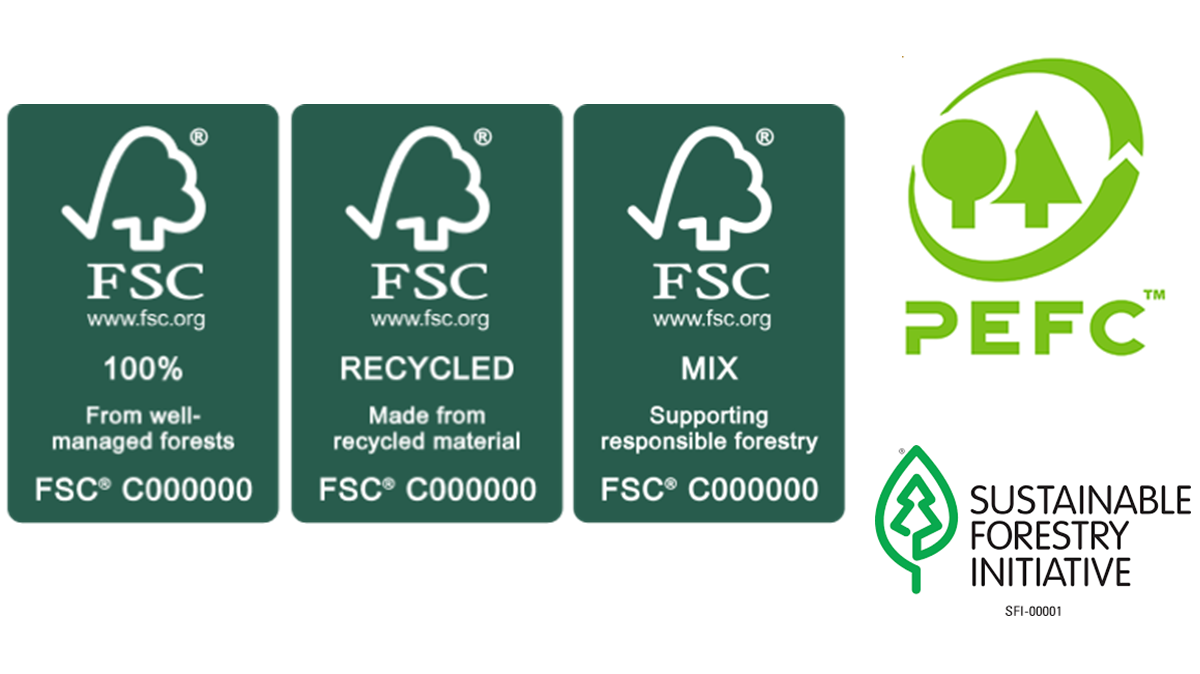
Weak areas include transparency, traceability and a failure to consistently disassociate from companies associated with deforestation. Two case studies are presented, including Korindo – a Papua-based company that has allegedly deforested for palm oil production and should therefore not be eligible to sell FSC-certified wood. Even so, Greenpeace acknowledges that FSC is the best forestry certification program, compared to the others such as the Programme for the Endorsement of Forest Certification (PEFC) and Sustainable Forestry Initiative (SFI).
While there is room for improvement in the FSC system, FSC certified forests and 100% FSC certified products do provide important forest, wildlife and Indigenous rights protections, whereas SFI certification cannot be considered anything more than a greenwash.
For Pulp & Paper Products, FSC 100% is typically the best available option when recycled is not available.
High-quality research on the FSC
As with the other third-party certifications, the best way to evaluate the FSC is via peer-reviewed scientific literature. But obviously few have time for that so I’ve done it for you!
Impact of FSC certification on endangered species in western Africa
I’m going straight to a recent high-quality paper (Nature, 2024), in which the researchers used camera traps “to assess whether FSC certification can mitigate the negative effects of timber extraction on wildlife” in western equatorial Africa.
Monitoring mammal populations is a good way to measure the impact of certification on the health of forest systems as it gets to the heart of whether the ecosystem is still healthy. Think of rainforest replaced by palm oil plantations – there are still trees in the area but a uniform monoculture of palms is no longer a suitable habitat for orangutans. On the other hand, a forest that is managed well, with trees harvested in patches and then allowed to regenerate, can still allow large mammals to thrive.
After collecting and cataloging nearly 1.3 million photos from camera trap data in Gabon and the Republic of Congo, the researchers compared wildlife populations between FSC-certified and non-certified forests. Here’s a key figure:
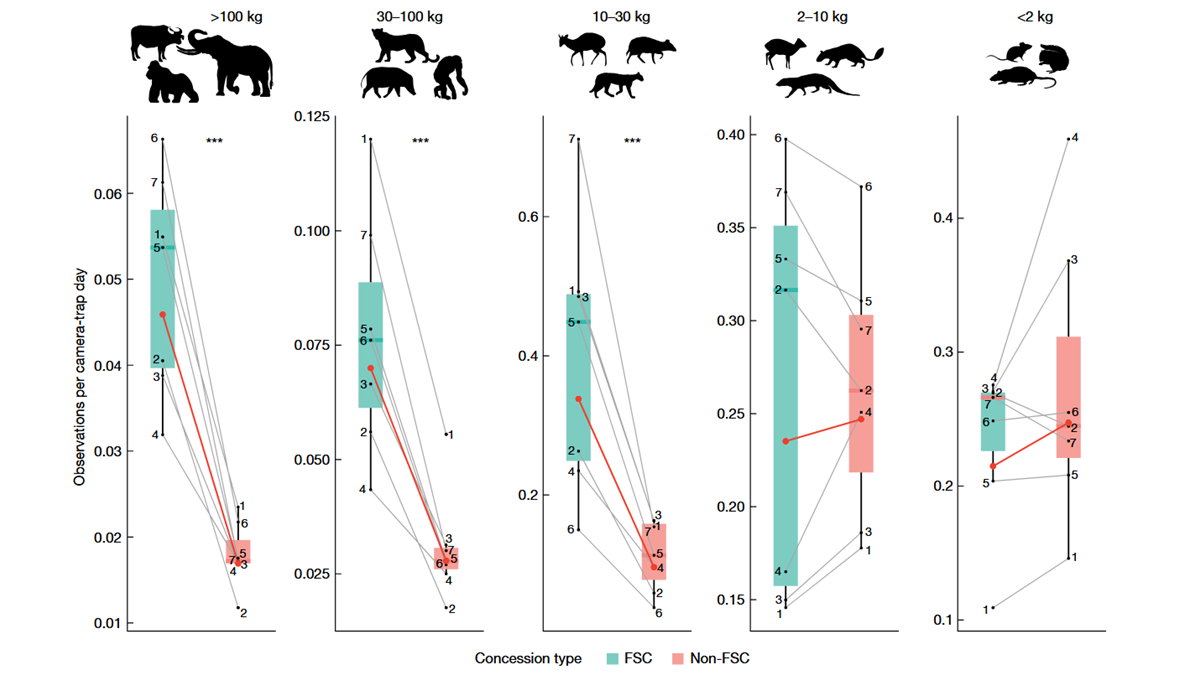
Animals over 10 kg were around three times more abundant in FSC-certified forest than non-certified forest while smaller animals such as rodents were about equally abundant in the two categories of forest. Mammals categorized as critically endangered (IUCN Red List) were 2.7 times more abundant in the FSC-certified forest.
Our results confirm that FSC-certified forests support far more larger and threatened species than do non-FSC forests. A particularly strong effect of FSC certification was found for the critically endangered forest elephant, which is in line with previous findings.
Conservation of large mammals through FSC certification brings wider benefits to forests, as these mammals play a pivotal role in ecological processes.

FSC certification helps preserves habitats by requiring maintaining low-impact logging practices and the protection of high conservation value forests, but also by making sure that roads are not available to poachers.
A major concern for biodiversity is that timber extraction—by the creation of roads—opens previously remote forests, enabling illegal and unsustainable hunting. This indirect effect of logging is known to mainly influence medium- to large-sized forest mammals, which are particularly vulnerable to human pressure.
FSC certification may alleviate these pressures because, among other measures, companies reduce accessibility to concessions by closing off old logging roads, prohibit wild meat transport and hunting materials, provide access to alternative meat sources for workers and their families, and carry out surveillance by rangers.
The researchers concluded that properly managed FSC-certified forests can significantly contribute to the preservation of biodiversity, based on their own results and other work discussed in their paper.
In African tropical forests, FSC certification has been shown to be associated with reduced deforestation, improved working and living conditions of employees and benefit-sharing with neighbouring institutions. Studies in Latin America suggest that mammal occupancy in FSC-certified sites is comparable to that of protected areas.
Impact of FSC certification in Latin America
In one of the Latin American studies mentioned above, an international team used camera trap data to quantify large animals such as jaguars in the Guiana Shield, north of Brazil. The scientists reported that jaguars and ocelots were as abundant in FSC-certified forest as in fully protected forest, attributing success to the following:
Involvement of local communities in forest management, control of forest access, and nesting production forests in a landscape that includes protected areas seemed important for these positive biodiversity outcomes.
The authors state that “areas allocated for industrial logging and community-owned forests account for over 50% of all remaining tropical forests,” making it clear that responsible forestry programs are essential.
Community partnerships, like the one in this case study, can increase conservation gains through improved forest management while they contribute to local livelihoods and achievement of development aspirations.
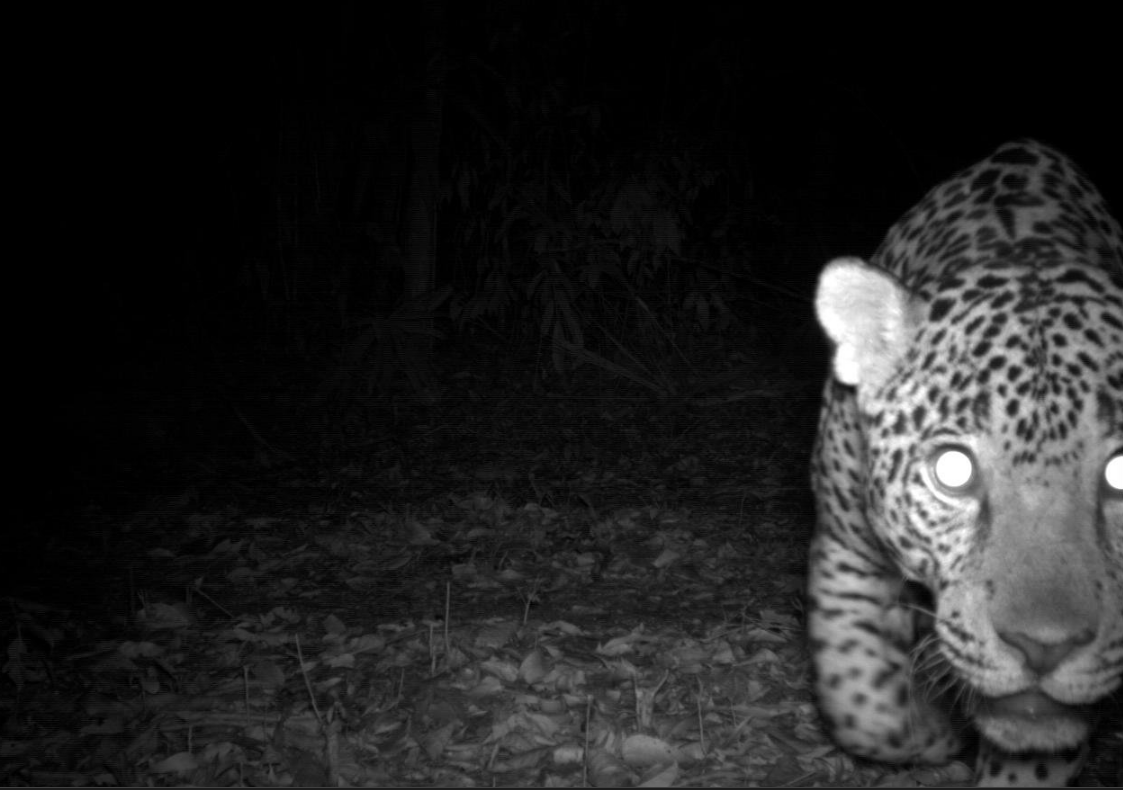
Another study, published 2018, focused on jaguars and other large/medium animals in Guatemala and Peru, reporting:
Our results indicate that well-managed logging concessions can maintain important populations of large and medium-sized mammals including large herbivores and large carnivores as long as hunting is controlled and timber volumes extracted are low.
Responsible forest management would therefore be an ideal activity in the buffer zones and multiple use zones of protected areas creating much less impact and conflict than alternatives such as agriculture or cattle ranching while still providing economic opportunities.
So the message is again that responsible forestry is much better than alternatives, such as the production of meat or palm oil.
We believe that well-managed, certified logging concessions have far less negative effects on forest ecosystems than alternative land uses such as cattle ranching, palm plantations and mono-cultures that result in deforestation and drastic reductions in biological diversity.
Other research on FSC efficacy
Here a brief rundown on other peer-reviewed papers that evaluate the effectiveness of the Forest Stewardship Council.
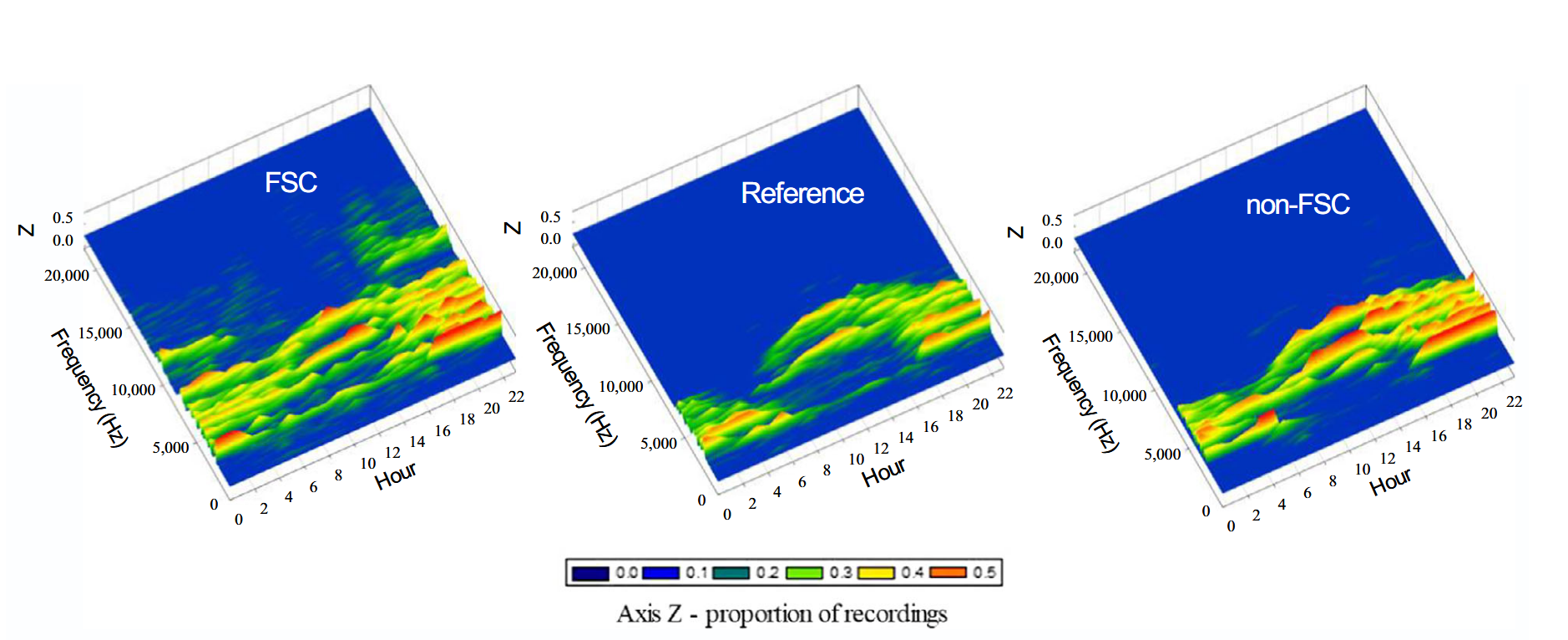
How does FSC forest certification affect the acoustically active fauna in Madre de Dios, Peru? (2019)
These scientists judged biodiversity by sound recordings made in FSC-certified versus non-certified forest in Peru.
Our findings correspond with the conclusions of other studies that certified forests can maintain levels of fauna biodiversity similar to those of undisturbed primary forest in the Amazon region.
The figure below is a nice way of visualizing the soundscapes (audible sound frequencies plotted against time of day) in FSC-certified versus non-certified forest.
Do forest-management plans and FSC certification help avoid deforestation in the Congo Basin? (2020)
The researchers found that deforestation was 74% lower in areas that had a Forest Management Plan such as FSC certification and that this effect grew over time.
We find that between 2000 and 2010, deforestation was 74% lower in concessions with an FMP [a Forest Management Plan such as FSC certification] compared to others. These findings suggest that FMPs help avoid deforestation by allowing logging companies to rotate cycles of timber extraction thereby avoiding the overexploitation of areas that were previously logged, and by the better regulation of access to concessions by closing former logging roads to limit illegal activities such as shifting agriculture, hunting and the illegal harvest of timber or fuel-wood.
Tradeoffs in Timber, Carbon, and Cash Flow under Alternative Management Systems for Douglas-Fir in the Pacific Northwest. (2018)
This paper on the impact of FSC certification on carbon storage is cited on the FSC standards page:
Peer-reviewed research has shown that FSC practices in western Oregon’s and Washington’s Douglas fir forests remove and store at least 30% more carbon from the air on average than other forests.
The authors of the study conclude:
Our work clearly demonstrates that the adoption of certain forest practices including expanded riparian protections, increased green tree retention, and the extension of rotation ages can translate into substantially higher carbon storage than contemporary common practice for Douglas-fir management in the Pacific Northwest.
The combination of forest practices required for FSC certification always stored more carbon than business-as-usual
Using certified timber extraction to benefit jaguar and ecosystem conservation. (2017)
This group used camera trap data to monitor jaguar populations in in Bolivia, French Guiana, Nicaragua, and Guatemala. They found evidence that adequate logging management can maintain jaguar populations as long as access and hunting is restricted. Sites certified by the Pan European Forest Council (PEFC) were at greater risk from hunters. As discussed above, Greenpeace has also been critical of the PEFC and believes that the FSC is more effective.
Impacts of nonstate, market-driven governance on Chilean forests (2016).
FSC certification was more effective in slowing forest conversion than [more industry-friendly programs].
Summary: Ranking of FSC versus other certifications
After initially looking at some critical articles online (discussed above), I was half-expecting that I would not be recommending the FSC. However, I felt different after completing my research as almost all peer-reviewed scientific studies report significant benefits from FSC certification. Even the paper that the critical Yale360 article relies on (which was not peer-reviewed) was not damning – it concluded that the FSC’s impact on deforestation “may be limited.”
This thinking also misses the point – or I could say that it misses the African forest elephants and jaguars for the trees. Responsible forestry entails harvesting wood from forests so that we can have furniture (or chopping boards) made from renewable carbon that’s captured from the atmosphere, instead of being made from fossil fuels (plastics and other synthetics). Responsibly-harvested areas are allowed to regenerate and are also interspersed with undisturbed zones.
Studies show that FSC-certified forestry is one of the most effective ways to maintain native mammal populations and biodiversity in general. FSC certification is better than the other major sustainable forestry certification programs and responsibly-managed forestry is significantly better than land conversion for beef or palm oil. Larger mammals, whether herbivorous (e.g., gorillas) or predatory (e.g., big cats), are critical to maintaining balance in complex ecosystems such as rainforest.
The Yale360 article bemoans that around 85% of FSC-certified forests are in North America and Europe, as if this is a terrible thing (that the FSC is not more active in the tropics). But it’s actually a good thing that we source most of our wood and paper products from temperate forests than from rainforests.
Of course, the FSC is not perfect (what is?) but it’s widely considered by experts to be an effective certification program for responsible forestry. Here’s a summary of how I feel about the certifications examined so far on the GSP.
Forest Stewardship Council – Support. It’s the best certification for responsible forestry, especially FSC 100%.
Fairtrade International – Support. Fair trade certifications are effective in addressing extreme poverty.
Rainforest Alliance – Needs to improve on weak standards and implementation to be worthy of support.
Until next time!
Discover more from The Green Stars Project
Subscribe to get the latest posts sent to your email.

Thanks so much for this incredibly well‑researched and objective deep dive. It’s refreshing to see someone take such care to evaluate which forestry standards are truly trustworthy (and, honestly, the world needs that kind of clarity more than ever).
My dad spent years in the US Forest Service and now teaches agriculture at Tuskegee, so sustainable forest stewardship is something I truly care about because of him. I share the concern you raised around transparency and impacts on biodiversity – especially as climate change accelerates and our forests become even more vital carbon sinks and wildlife habitats.
What stood out most to me was your emphasis on rigorous, science- and data-driven evaluation of these organizations. That attention to nuance highlights the important fact that forestry is about more than just trees – it’s about communities, ecosystems and our collective future. Amen to all of that.
Thanks for consistently engaging so thoughtfully in this space. I hope your work continues to inspire better practices in forestry and beyond.
LikeLiked by 1 person
Hey Andrea!
Thank you for your lovely comment. It’s so nice to hear about your love of forests coming from your dad’s work. I saw on the news this morning that the EPA is being further dismantled, so we need effective third-party certifications more than ever.
I wonder what your dad thinks about the repeal of the “roadless rule” by the current administration. Many of the science papers that I read while researching the FSC emphasized that the restriction of access to logging roads is an essential part of it’s success in protecting habitats and fauna.
And I totally agree – we can only reach informed conclusions by taking some time to evaluate the data. If the findings from independent, academic research (that’s peer-reviewed before publication) largely points to a particular conclusion, then we can have some confidence in trusting that.
Science, as a whole, often doesn’t communicate these conclusions to the public. So many of us end up being swayed instead by the opinion of somebody famous on X, however uninformed they may be. I’m glad to be of service – thank you again!
J
LikeLike
Is there anything not to feel sad about anymore, J?? :0(
LikeLike
The conclusion is that the FSC is effective and worth supporting, so it’s actually something to be happy about!
Cheers!
LikeLike