
Still feeling overwhelmed by the political situation in the US? Worn down by more than 100 days of mayhem? Wondering what useful actions you can take? If you answered yes to any of these questions then stick around! I’m not getting into the politics here, other than an attempt to put it into perspective. The powers that be have a highly distorted perspective on reality (believing that they are the heroes of a movie, combating heinous threats like diversity, inclusion and global cooperation) so it’s important that we rise above that.
They are breaking a reality that is mostly harmless and replacing it with a completely artificial state of conflict and violence constructed by themselves. – No Bull
We really need to maintain our own perspective on life – to ignore the fear mongering that has become the main strategy of the leaders of the free world so that we can actually create change. Many of us feel that we are helpless on the sidelines, watching as new horrors unfold every day and wishing there was something we could do. Well there is.
This post is not about how to create change in the US Government, at least not directly. It’s about not allowing the fiasco in Washington to distract us from something that, in the big scheme of things, is actually much more critical.
Staying on our path
I’m going to use the metaphor here of getting through your college finals, since I’m surrounded by graduating students as I write this. Let’s say you’re studying like crazy for your upcoming exams and stressed out about your future. Then your unstable uncle comes to stay (or an unstable neighbor moves in upstairs) filling your world with chaos and noise. One approach is to exhaust all of your energy arguing with your uncle/neighbor with the upshot that you fail your exams (and then they move out of their own accord anyway). The other approach is that you don’t let them ruin your life, finding ways to work around the situation.
What I’m getting at with this metaphor is that we should not let the Washington circus, which is temporary, distract us from the longer-term view of maintaining life on Planet Earth. In time (not long!) this political era will reduced to an uncomfortable memory – hopefully one that we can even laugh about, in relief. But, around the same time, our kids, nieces/nephews, grandchildren, friend’s kids, etc. will be facing an environmental situation that’s fast approaching Defcon-5.
I’m not saying that we shouldn’t go out and protest or take other political actions such as supporting candidates for the 2026 midterm elections. I’m proposing (to continue with the metaphor) that we take an approach that fits two goals – passing our exams and finding ways to work around our unstable uncle/neighbor until they move out.
The non-metaphorical version of the approach that I’m proposing is that we get serious about ethical consumption so that we can:
- Avert the collapse of our planet’s ecosystems.
- Support rather than exploit the Global South.
- Address corporate-political hegemony.
This is a crucial time to support companies that don’t capitulate to far-right whims such as the denial of climate change.
Over the summer, I’m going to launch another ethical shopping guide, as the original articles (Daily Footprint) are a decade old now. (This new guide will also constitute the final major chapter of my book-in-progress.) But in this post I will focus on the most important action we can take if we want to save the planet.
Our most important action: Quit beef
That’s probably more specific than you were expecting – or maybe not, if you’re a regular reader. Many of the themes examined over the last year (here on the GSP and for my book) have led to the same conclusion: To stop eating beef is the single-most important action we can take to mitigate our more pressing social and environmental problems.
[Regular readers: the next section will be a clips show of recent GSP material. Bear with me – next week will be a new episode!]
Planetary Boundaries
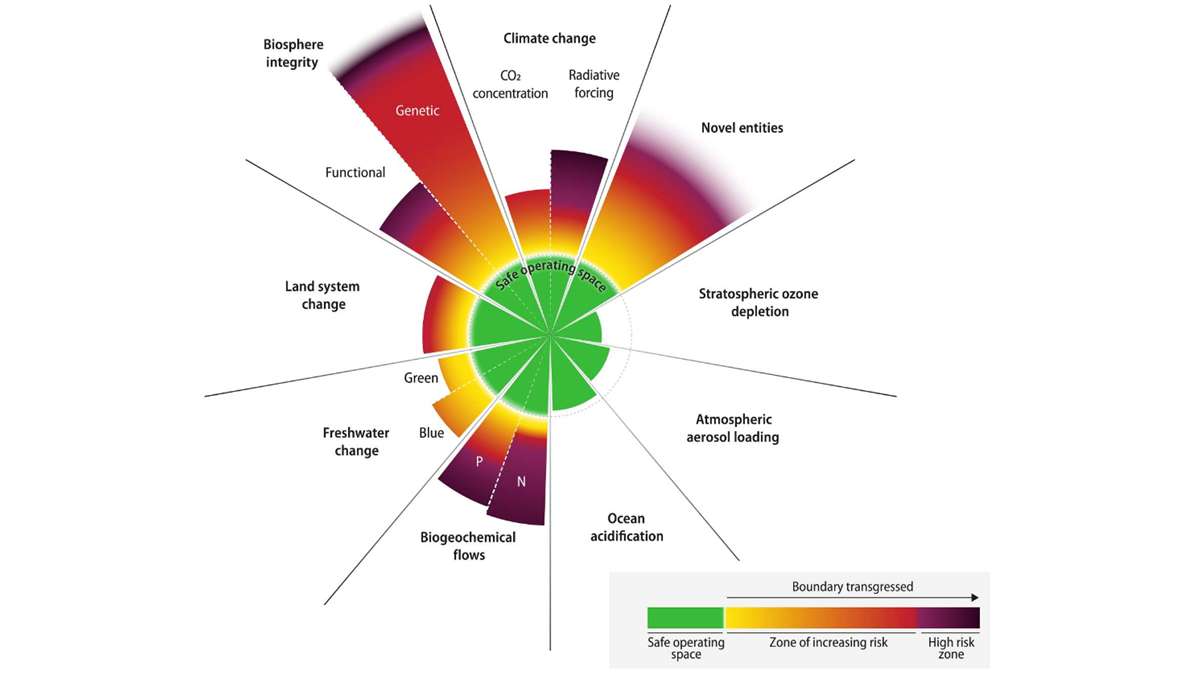
Let’s start with the planetary boundaries – the nine major environmental threats that we face, as agreed by an international team of scientists. We have transgressed the safe operating space for six of these boundaries and almost all of them are largely driven by meat industry, and especially by beef production:
- Climate change
- Land use change (deforestation)
- Nitrogen and Phosphorus pollution
- Freshwater use
- Biosphere integrity (biodiversity losses)
- Novel entities (e.g., bird flu, microplastics, toxic chemicals)
Meat production and especially meat from ruminant animals is a major driver of the first five threats on the list above. Ruminants such as cows and sheep have a unique digestive system that makes them less efficient for meat production (compared to pigs and chickens) and also generate the potent greenhouse gas methane. Beef represents the major source of meat from ruminants so that’s why I’ve focused on beef (but lamb is also up there).
Environmental footprints of beef
For most of the data linking beef production to the planetary threats listed above, see my post on the environmental impacts of meat and other foods. I’ll just take one example here – greenhouse gas (GHG) emissions. Here’s a good way of putting the carbon footprint of beef in perspective:
If we imagine that everyone on the planet eats 1 lb. of beef per week, our collective carbon footprint – just for this beef – would be 19 billion tonnes of CO2 equivalents (CO2-eq), increasing the planet’s emissions by one third. Beef consumption per capita in the US is already over 1 lb. per week – if the whole world followed suit, we would effectively close the book on our future. – The environmental impacts of meat and other foods
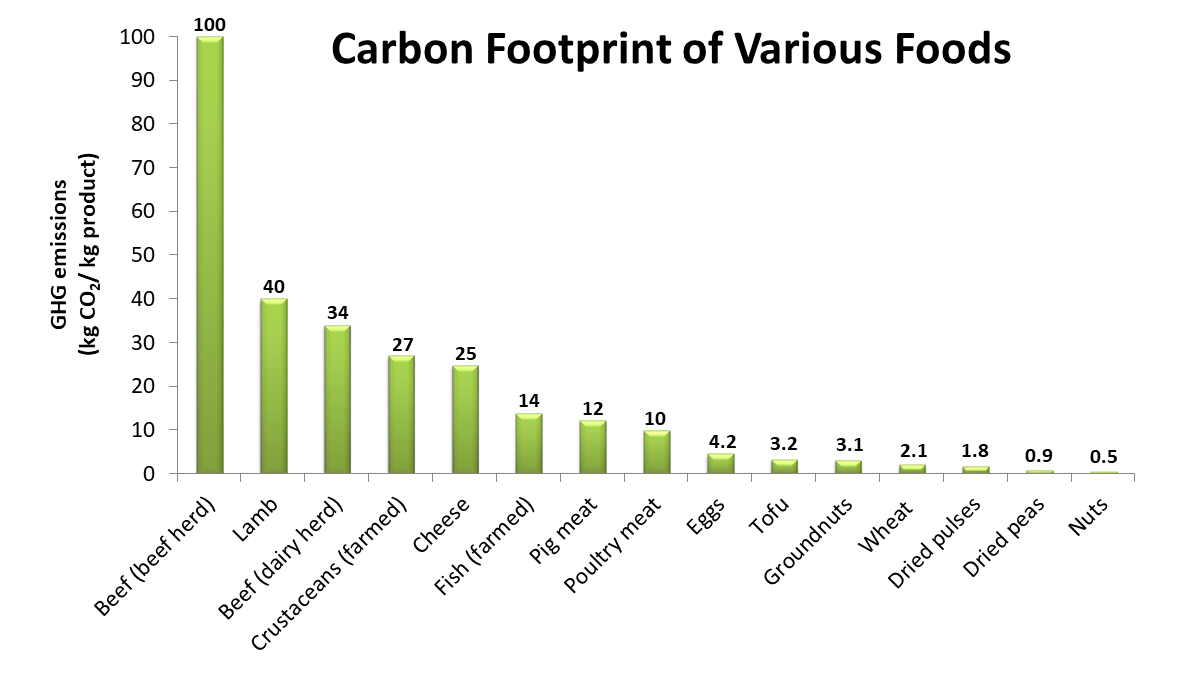
Not many items in common use have carbon footprints even close to that of beef. When we talk about GHG emissions, materials like steel often come up as huge contributors, but the carbon footprint of 1 kg steel (around 6 kg CO2-eq for stainless steel, to take one of the highest values) is much smaller than that of 1 kg beef (100 kg CO2-eq, on average). And think about how long a stainless steel cookware set lasts compared to a piece of beef. Of items that we commonly consume or use, almost nothing comes close to the carbon footprint of beef – only other products from ruminants such as lamb (40 CO2-eq per kg) and cheese (25 CO2-eq per kg).
The high carbon footprint of cheese is something to take note of too – that was a bit of an eye-opener for me when I researched it. It turns out that eggs have much lower environmental footprints than cheese – important info for vegetarians, or anyone deciding between the two. So, as a vegetarian who has eaten cheese for years, I realized that I have changes to make too. This is why I’m always on the lookout for good vegan cheeses on Ethical Bargains.
The carbon footprint of beef is huge but actually beef’s land footprint is even bigger, relative to other foods. The amount of land used either for direct cattle grazing or for growing cattle feed is perhaps the biggest threat to biodiversity and the world’s forests.

Rather than a recap of each post, I’ll refer you to them for more information:
How to feed the world without further deforestation – this post goes into more detail on the consequences of beef’s huge land footprint.
How to reduce your water footprint – The most effective way to reduce our water use is via our diet, specifically reducing meat intake.
The social impact of meat –slaughterhouse work causes a kind of post-traumatic stress disorder called perpetration-induced traumatic stress (PITS). It’s also associated with a higher rate of violent crimes, compared to other industries.
The ethics of dairy – an important post for me as it gets into the impact of dairy on calves and their mothers. Another incentive to reduce cheese consumption.
Quitting beef is a reasonable request
Last November, on Reddit, I shared a post on the US election result and climate change – the gist of the post being that our personal actions are the main drivers of climate change. Many reactions on Reddit were unreasonable (don’t tell me what to do) but there were some understandable protests such as, how do you expect me to get to work?
When we consider the options that are available to people, we have to be cognizant of which actions are feasible. Expecting everyone to avoid driving to work makes a lot of assumptions about the availability, practicality and pricing of other options. However, everyone is capable of reducing/eliminating beef consumption.
Besides being an action that’s within reach, it’s an action that has unique positive impacts with no substitute. In other words, many of our current activities such as transportation are becoming more sustainable over time. There’s no fix for beef production – other than plant-based alternatives, of course. Even if we had massive-scale CO2 and methane capture, this would only ameliorate one impact of meat – the destruction of rainforest is much harder to reverse.
Substitutions for omnivores
For omnivores who want to continue eating meat, the best choices are poultry and pork. For pescetarians, choose wild-caught small pelagic fish (sardines, herring, mackerel, anchovies, etc.) and salmonids (salmon, trout, char) or farmed bivalves (avoiding and most other farmed fish and crustaceans). For vegetarians, eggs have significantly lower environmental footprints than cheese. Choose pasture-raised chicken or eggs. Take a look at the charts on the environmental footprints of meat and other foods and the post on sustainable seafood for more information.
Whatever you decide, there’s one clear choice to radically improve your impact on the planet – choose legumes over beef – but even if you do continue to eat meat, just cut out the beef. Let’s not let a temporary glitch distract us from our purpose – protecting our planet for future generations.

Discover more from The Green Stars Project
Subscribe to get the latest posts sent to your email.
 The Green Stars Project
Getting everyone on board is not easy. While I’ve embraced a vegan diet, mostly for health reasons, my two sons remain meat lovers.
LikeLiked by 2 people
That’s why I think the modern meat substitutes are so important. For people who don’t want to give up experience of eating meat they provide a really similar experience, but actually healthier. Even though I gave up late a long time ago I still really enjoy products like beyond burgers and quorn tenders
LikeLiked by 2 people
I think people have to be aware of their decision to protect our planet for the future . Well shared
LikeLike