

The 2024 election result was a shock, to say the least, and it has been a bit of a roller coaster since then.
On Tuesday, a few hours after a beautiful sunset, the atmosphere in Berkeley transitioned from laid back and fairly normal to incredibly quiet and ominous. It felt like a dark veil had descended on the Bay Area. I went to bed early, while there was still a sliver of hope that I might be awoken by the sound of celebrations in small hours.
Maybe it’s because I had a good night’s sleep, but I was able to function on Wednesday after allowing myself some time to process. There have been waves of horror, now and then, but I noticed that people were making an extra effort to be nice to each other, and that helped a lot. I remembered that this happened after the 2016 election and after the outbreak of Covid-19, and in fact it happens often when humans face a challenging situation.
Some companies also step up in response to challenging situations so, in the next post, I’m going to discuss the increased importance of supporting ethical companies during this era.
In this post, I want to talk about the impact of the election result on climate change.
US Response to natural disasters, 2025-2028
It doesn’t take a psychic to predict that there will be some severe weather events over the next four years and that the government response will be inadequate. As discussed in the most recent round of IPCC reports, if the global temperature increases by 1.5-2.0°C then extreme temperature events will become around 10 times more frequent and also more extreme. The temperature had already risen by 1.1°C by 2020, so reaching this 1.5-2.0°C range is inevitable at that point.
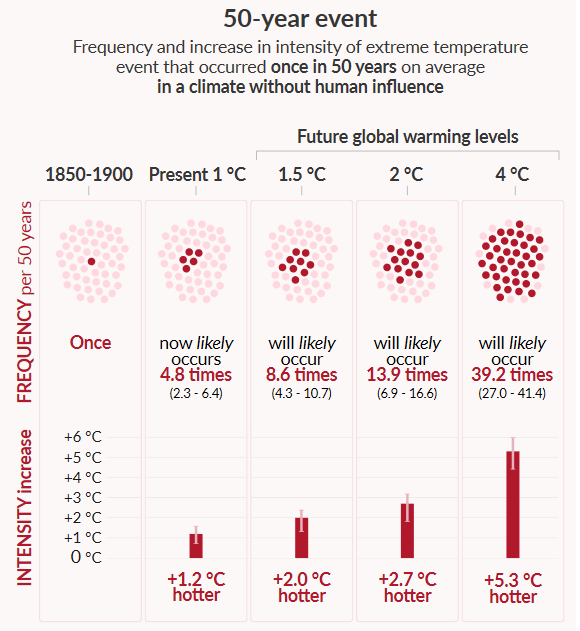
So there is a high likelihood of large-scale natural disasters and there is also a high likelihood of an inadequate government response, based on many precedents. For example, relief for Puerto Rico following Hurricane Maria was actively blocked by the Trump administration in 2017.
But enough of that – this week has been bad enough and projecting into the future is a little too much to bear, right now. I just want to emphasize that climate change is the biggest existential threat to life on earth and that we need to remember this and to act on it, after we’ve had a moment to mourn.
Importantly, we need to know that our ability to mitigate climate change largely depends on us, personally, not on the government.
Especially now.
Climate change is largely driven by individuals
Two Norwegian scientists studied the breakdown of greenhouse gas (GHG) emissions between governments and individuals. Here’s a quote from their paper, Carbon Footprint of Nations: A Global, Trade-Linked Analysis:
On the global level, 72% of greenhouse gas emissions are related to household consumption, 10% to government consumption, and 18% to investments.
Significant greenhouse gases (GHGs) result from the construction of buildings and infrastructure, which the scientists categorize as “investments.” These investments in infrastructure take up 18% of a country’s GHG emissions, on average because concrete and steel have very large carbon footprints.
In 2022, the IPCC reported that industry (manufacturing) is responsible for 34% of global GHG emissions. Just two materials, cement and steel, account for almost half of this, with each being responsible for roughly 7% of total global GHG emissions. – My upcoming book 🙂
But what I want to focus on here is that individuals are responsible for 72% of a country’s GHG emissions, on average.
For the US, this is actually higher – 82% of US emissions result from the action of individual American residents.
Here’s what the breakdown of GHG emission sources looks like, according to the Norwegian scientists:

Note that in America, the percentage of household GHG emissions resulting from manufactured products and mobility is higher than in the image above. (i.e., Americans buy more stuff and travel more.) Let’s take a look at a more recent paper that specifically examines GHG emissions from US households, and strategies for their reduction.
US households: how to reduce GHG emissions and save money
Two years after the Norwegian paper, two scientists from UC Berkeley (Dr. Christopher Jones and Prof. Daniel Kammen) developed a carbon footprint calculator called CoolClimate, which I’ve previously written about.
In their analysis of GHG emissions by US households, the researchers also estimated how much money can be saved by adopting methods to reduce emissions. In other words, they show many strategies that offer a win-win for people who adopt them – they can reduce their carbon footprint and save cash at the same time. In the figure below, the different strategies are charted according to how much GHGs they will reduce (X-axis) and also by how much money they save (Y-axis).
So, for example, the green block on the left side of the chart corresponds to strategy A: change diet (i.e., eat more plant-based food). This strategy saves almost 2 tonnes of CO2 per year (width of the block) and can also save the household $600 per year (depth of the block).

Take a look at the paper for more examples – they examine case studies of households in San Francisco and St. Louis, and show how their opportunities to reduce GHG emissions are slightly different, although diet and transportation are still the big ones in both cities.
I recommend you try calculating your carbon footprint using the CoolClimate calculator (read about my experience with using CoolClimate or go directly to the calculator).
I also recommend you set yourself a target carbon footprint of 7 tonnes CO2 equivalents, and aim to reduce that further by 2030.
I understand that some things are harder to change (e.g. commuting to work) and that’s why I often emphasize adopting a mainly plant-based diet. It’s a strategy that everyone can take, at least to some extent. Also, while many aspects of our lives, such as transportation, are gradually decarbonized, meat and dairy is not going to suddenly become more sustainable.
No matter which way you voted, if you are a US resident then odds are that your carbon footprint needs to come down.
So our fate in still our own hands and, in fact, one of the best ways to get through challenging times is to have a mission.
Discover more from The Green Stars Project
Subscribe to get the latest posts sent to your email.

It is an important start for individuals to thoughtfully reduce consumption, James, but there are so many ways we could work together as small neighborhoods or communities to share things like laundry facilities, gardens, collective kitchens for preserving and storing food, sharing tools and skills, etc. I know from my own experience on a commune in the early 1970s that It would not be easy, but it’s something we need to consider. It may well be what we will ultimately need to do to survive.
LikeLiked by 2 people
Hi Carol,
For sure, we should think of it as a community effort. I need to remember to emphasize that sometimes – thanks for the reminder.
The Berkeley Public Library has a tool lending section, which is a great idea. I own virtually no tools other than a Swiss Army knife and an adjustable wrench 🙂
I’m currently reading How to Do Nothing by Oakland artist/writer Jenny Odell – a good bit of it is dedicated to examining the communes of the late 60’s and 70’s. I think you’d like it!
J
LikeLiked by 1 person
Thank you for your thoughtful reply, James. I recently watched a Netflix documentary (Join or Die) about Robert Putnam’s study and book, “Bowling Alone” that explores “The Collapse and Revival of American Community.” Curious, I began this weighty but important work.
The book you’re currently reading sounds interesting. I wonder if the author has included the commune I lived it for more than 4 years, and/or the one I explored from the periphery. I will try to check it out.
LikeLiked by 1 person
Sounds like a good book – I’ve requested it from the library. Thanks!
I can let you know if your communes turn up if you’d like to tell me their names 🙂
She also discusses Epicurus’s Garden School in ancient Greece – a free school that was open to everyone.
https://en.wikipedia.org/wiki/Epicurus
LikeLiked by 1 person
Hi James, this is very unexpected. I did quick internet search to find info on one of the communes and lo and behold, there is a WP blog, videos, and a library repository I don’t believe I ever met the author/administrator of the WP blog but the intro I skimmed seemed to be objective and accurate. I can send the name or a link if you’re interested. 😂
LikeLiked by 1 person
Sure – you can comment with a link to the blog.
Sounds like we’re both going to be off on a tangent for a while 🙂
LikeLike
Hi James. Here’s a link to the blog: https://brotherhoodofthespiritblog.wordpress.com/
Googling “Brotherhood of the Spirit Commune” opens a lot of possible links. I’m not likely to visit any soon. I was grateful to escape when I did. The next stop was near the Stelle Community in central Illinois: https://en.wikipedia.org/wiki/Stelle,_Illinois.
And here’s an old post with a bit of information about both: https://voices-from-the-margins.blog/2014/03/15/in-search-of-community/. I had an interesting opportunity to write about my experiences from a critical sociological perspective a few years later, and I remain grateful for that chance. Mostly, I remember all of the opportunities I had to develop skills I would never have dreamed of…
LikeLiked by 1 person
Thanks for this informative post. I was not aware of the Norwegian paper on “Carbon Footprint of Nations: A Global, Trade-Linked Analysis.”
LikeLiked by 2 people
Cheers Rosaliene!
Unfortunately, the scientific literature on climate change is not that widely read – even among fellow biologists.
I’ll strive to bring the most important work to your attention 🙂
Cheers!
James
LikeLike