
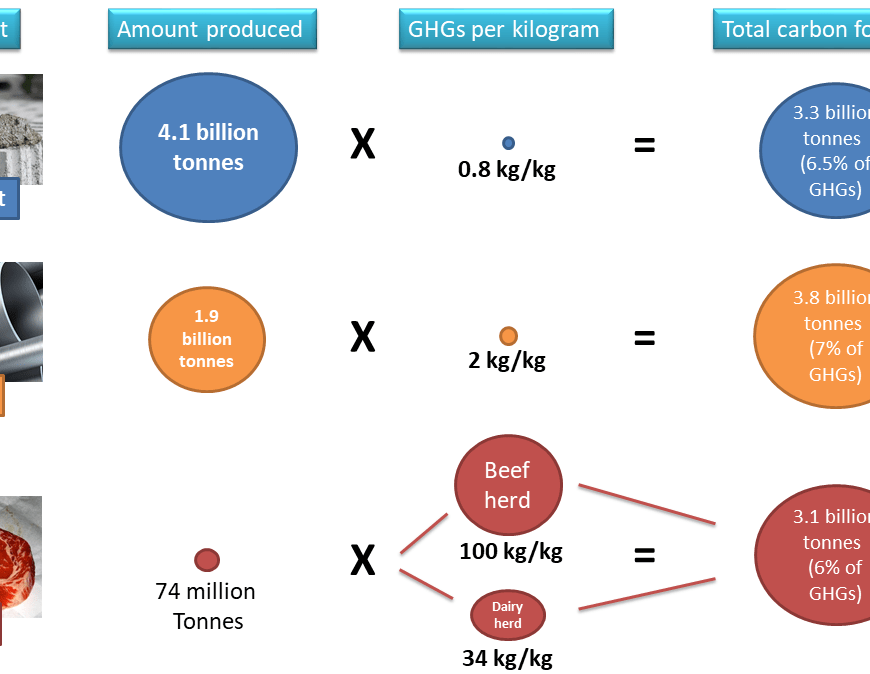
The image shows three products - cement, steel, and beef. Next to images of these products is data showing the amount produced globally (4.1 billion tonnes, 1.9 billion tonnes, and 74 million tonnes, respectively) and then greenhouse gases per kilogram (0.8, 2, and 100 kg CO2/kg product, respectively). The final column shows the total carbon footprints for these three industries, representing around 6.5%, 7%, and 6% of global GHGs, respectively.

Perspective on the carbon footprints of steel, cement, and beef

Globally, we produce way less beef compared to steel and cement and yet the beef industry’s total carbon footprint is as large* as that of the other two industries. This is because the carbon footprint of beef, per kg of product, eclipses virtually everything else on the planet. The “carbon footprint multiplier” for beef is 100 while for cement and steel it’s around 0.8 and 2, respectively. While plans are in progress to decarbonize cement and steel, we need to put beef in perspective.

*It’s actually a lot larger if we factor in carbon sequestration on land formerly used for beef.
Continue reading Perspective on the carbon footprints of steel, cement, and beef

The cover of Bill Gates’s 2021 book, How to Avoid a Climate Disaster is shown. The book's subtitle is The solutions we have and the breakthroughs we need.

What Bill Gates missed in How to Avoid a Climate Disaster

I’m taking a look at Bill Gates’s 2021 book, How to Avoid a Climate Disaster. His book is full of useful information and hopefully has inspired changes in policy. Unfortunately, last week, Bill did the opposite of his own advice. My main issue with the book is that it downplays actions that we can take as individuals and consumers. Continue reading What Bill Gates missed in How to Avoid a Climate Disaster