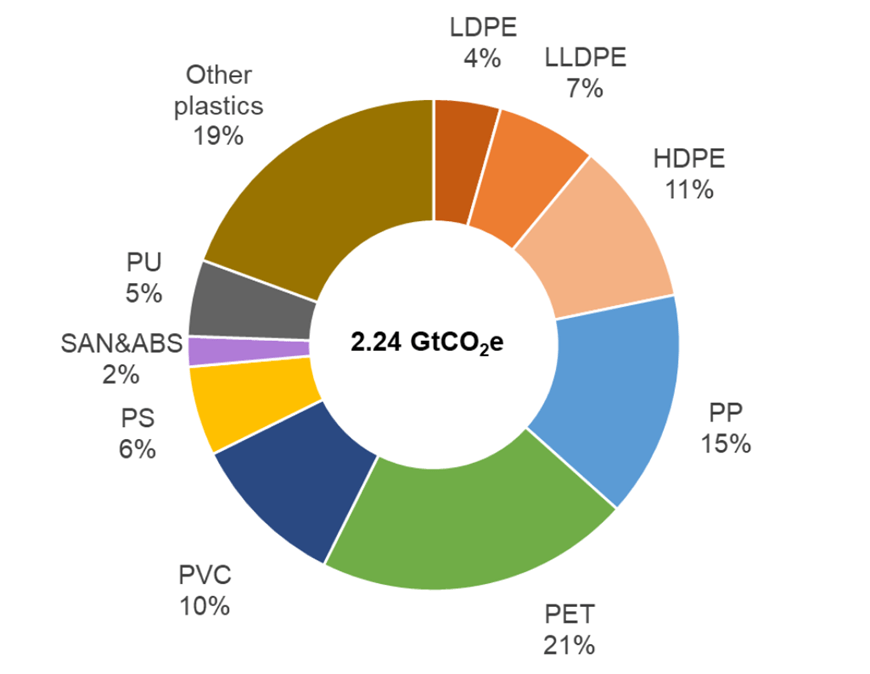
The carbon footprint of plastic production. A donut chart shows greenhouse gas emissions from plastic production in 2019 with a breakdown by plastic polymer type. Total GHG emissions are estimated at 2.24 billion tonnes CO2 equivalents. The plastics contribute to this total roughly in proportion to the amount of each plastic produced per year. Major contributors are polyethylene terephthalate (PET), polypropylene (PP), high-density polyethylene (HDPE), and polyvinyl chloride (PVC).

The astonishing carbon footprint of plastic production

Last year, scientists from Lawrence Berkeley National Lab reported that the carbon footprint of plastic production is around 2.2 billion tonnes of CO2-equivalents. That’s more than double previous estimates, amounting to more than 4% of global greenhouse gas emissions. If the plastics industry continues to grow at the current rate, it will be one of the biggest drivers of climate change by 2050. Continue reading The astonishing carbon footprint of plastic production

Three seafood certification logos are shown in a row: Marine Stewardship Council (MSC), Fair Trade USA, Friend of the Sea.

Are seafood certifications useful? Consider these two steps first!

I will examine the science on whether third-party certifications such as the Marine Stewardship Council, Friend of the Sea and Fair Trade are helpful for consumers seeking responsibly-caught seafood. However, before we look to certifications there are two other important factors that we should consider. Continue reading Are seafood certifications useful? Consider these two steps first!

On the left is the Forest Stewardship Council (FSC) logo - an outline of a tree, combined with a checkmark. On the right is a photo of a stag standing in a forest.

An evaluation of Forest Stewardship Council (FSC) certification

Certifications by reputable, independent organizations are extremely important when governments don’t value the environment and allow corporations to run amok. Certification by the Forest Stewardship Council (FSC) is designed to assure consumers that forestry-related products are produced without causing environmental damage. But is FSC certification effective? Continue reading An evaluation of Forest Stewardship Council (FSC) certification

Logos for messaging apps WhatsApp and Signal are pictured. Both are based around the image of a speech bubble: the WhatsApp logo is in green and white, while the Signal logo is blue and white.

Signal – an ethical replacement for WhatsApp

Moving from WhatsApp to Signal is an important action, right now. WhatsApp’s parent company, Meta, has been involved in several cases of election interference: America in 2016, Trinidad and Tobago in 2010, and Brazil in 2018. Mark Zuckerberg has apologized in the past but now, since his post-election dinner with Trump, wants “a culture that celebrates the aggression a bit more.” Continue reading Signal – an ethical replacement for WhatsApp

The Rainforest Alliance logo is shown. It's a circular logo consisting of a green frog drawing in the center, surrounded by the words: Rainforest Alliance, People & Nature.

Is Rainforest Alliance an effective certification?

The level of shade cover is one of the best ways to determine if forest habitats are being maintained. The good news is that shade-tolerant crops such as cacao can tolerate over 30% shade cover with no reduction in crop yield. The bad news is that the Rainforest Alliance standards on shade cover have weakened over the years – 15% cover is now considered adequate. This begs the question: Is the Rainforest Alliance worthy of your support? Continue reading Is Rainforest Alliance an effective certification?