

I’ve been evaluating various third-party certifications over the last few months here on the Green Stars Project (GSP). These posts also form the basis of a chapter of my book-in-progress on ethical consumption, which I’ll introduce soon. Each evaluation was quite long as there’s a lot of research to cover and I wanted to be as conclusive as possible. So for busy people who strive to make ethical choices, here’s a summary of the GSP position on eleven of the most common third-party certifications.
It feels a bit funny referring to the GSP position on… because I’m just one person. But it refers more to a method than a person – an objective process of examining social and environmental issues by evaluating the science (peer-reviewed papers).
It’s hard to find impartial opinions online – most organizations have agendas in one direction or the other. Articles topping Google search results (and AI-generated answers) are often written on tight deadlines by journalists who rarely have a mandate (or credentials) to dive into the peer-reviewed literature. In many cases – for example, examining the efficacy of the Forest Stewardship Council (FSC) – top opinion pieces are the polar opposite of the scientific consensus.
It took some time to investigate each of these certifications but it was worth it, as I was uncertain about some of them before I started this research. Effective certifications form a cornerstone of ethical consumption so it’s important to know which ones to support. I hope you find this summary useful – I’ll run through them in alphabetical order.
B Corporation
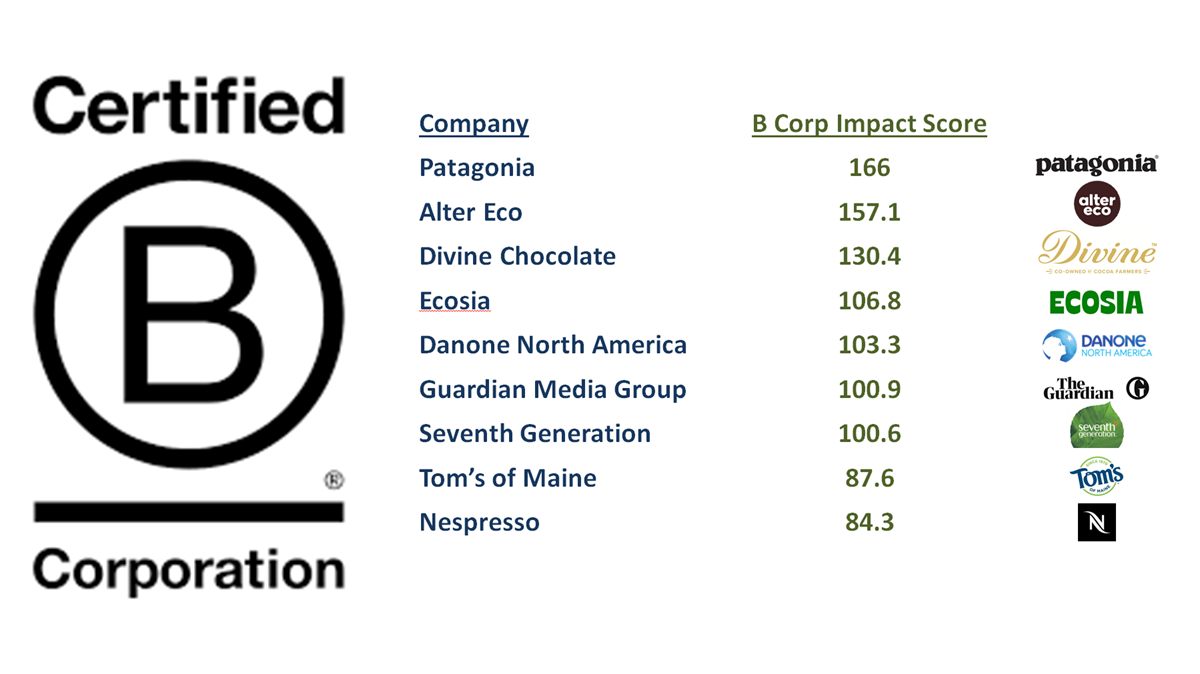
Support, with caveats. Certification by B Corporation indicates that a company is doing better than average on at least some social and environmental metrics. To qualify for certification, a company must receive a B Corp Impact Score above 80, while the average impact score for “ordinary businesses” is around 50.
Trust in and respect for B Corporation took a hit when Nespresso (Nestlé’s coffee pod company) by was deemed worthy of certification in 2022. But the debate that followed was encouraging – existing B Corp member companies are very much invested in the program maintaining high standards and B Corporation was responsive to criticism.
I consider a B Corp certification to be a good thing, but with a couple of caveats. It’s a good idea to check the company’s Impact Score and certainly to take a step back and consider what exactly the company is selling. For example, Danone North America has been B Corp certified since 2018 and the score has increased since then, surpassing 100. Even so, some Danone products (e.g., its plant-based brands So Delicious, Silk, and Follow Your Heart) deserve much higher Green Stars ratings than others (e.g., conventional dairy).
Relevant GSP posts:
- Does B Corp certified mean ethical?
- Follow Your Heart vegan blue cheese (on Ethical Bargains)
Compostable waste
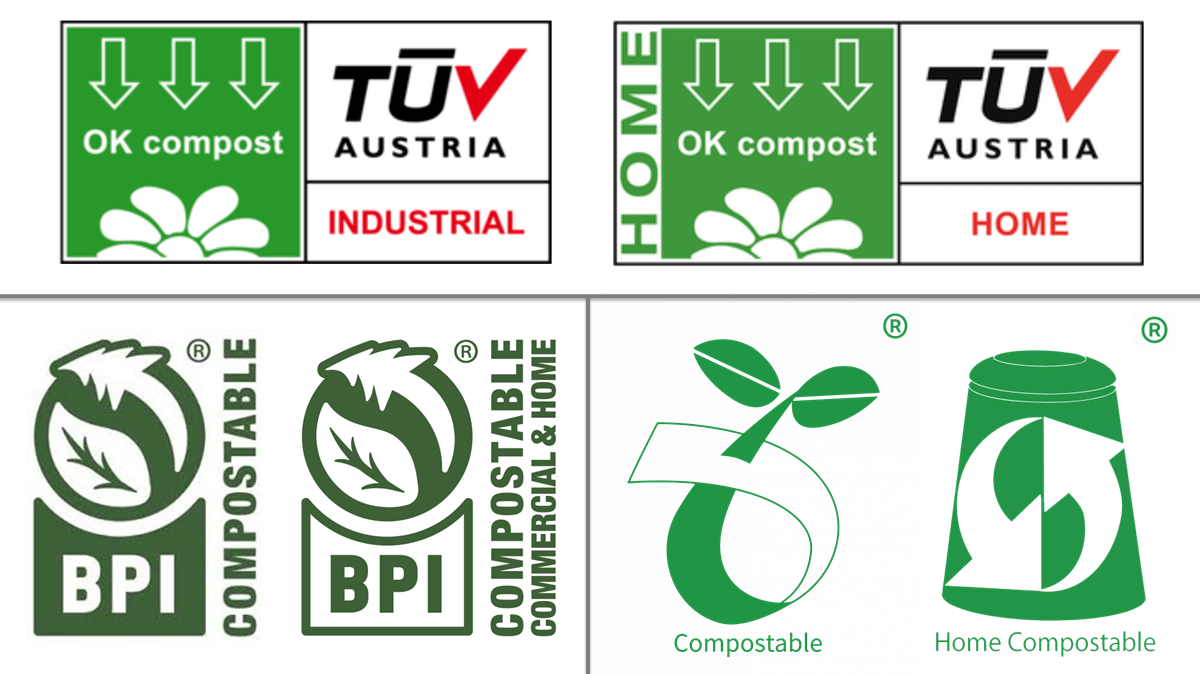
Support. Third-party certifications for compostable items help ensure that they really are suitable for composting (either at home or via your green waste bin) and are also free of PFAS (“forever chemicals”). Bio-based compostable plastics such as polyhydroxyalkanoates (PHAs) and polylactic acid (PLA) can be made from plant sugars by microbes. Being made essentially from CO2 that’s captured by plants, bio-based compostables have several big advantages over their petrochemical-based brethren. They are better in principle (green design principles) and often in practice too. The good examples (e.g., PLA from Nature Works) have significantly lower carbon footprints than conventional plastics.
At the rate the plastics industry is growing, its greenhouse gas emissions are going to be a huge issue in a decade or two (they’re already higher than air transport) and we need a lower-carbon alternative. For sure we should use reusable items whenever possible, but when a plastic is needed (e.g., food packaging) then look out for certified compostable. Compostable certifications are also helpful for household items like coffee filters and waxed paper, to make it clear that they are approved for composting.
Relevant GSP posts:
- Certifications for compostable waste: which to trust?
- The environmental impact of compostable plastics.
Fair trade
Support. Fair trade programs have been repeatedly demonstrated to improve income and quality of life in the Global South. Certification helps prevent farmers’ livelihoods being wiped out by commodity market crashes.
An area for improvement would be to extend benefits to hired workers. That said, at least one study showed that certification by Fairtrade International does particularly benefit the poorest households.An unexpected upside of fair trade certification is that it often brings environmental improvements.
There is overwhelming evidence that Fair Trade–certified producers do receive higher prices than conventional farmers for their products. – The Economics of Fair Trade

Relevant GSP posts:
Forest Stewardship Council (FSC)
Support. It’s the best major certification for responsible forestry, especially FSC 100%. The research on the efficacy of the FSC was fun to read about as it involved various methods from camera traps to soundscapes to evaluate how wildlife fared in FSC-certified forests. Certification did have large, statistically significant impacts on preserving endangered species such as African forest elephants and South American jaguars.
A particularly strong effect of FSC certification [of African tropical forests] was found for the critically endangered forest elephant, which is in line with previous findings. Studies in Latin America suggest that mammal occupancy in FSC-certified sites is comparable to that of protected areas. – Zwerts et al, Nature, 2024
Relevant GSP posts:
Friend of the Sea
Support. Friend of the Sea (FOS) is more focused on certification of fisheries in the Global South, while the Marine Stewardship Council (MSC) is more skewed towards larger Global North fisheries. Protection of fisheries in the Global South is especially important as they are more likely to be overfished, robbing locals of a critical food source.
In one study that evaluated the level of overfishing in certified fisheries, FOS appeared to be doing better than the MSC. However, either one of them (even with their flaws) is significantly better than nothing:
It is still reasonable to buy certified seafood, because the percentage of moderately exploited, healthy stocks is 3–4 times higher in certified than in non-certified seafood. – Marine Policy.
Relevant GSP posts:
- Are seafood certifications useful?
- What’s the most sustainable kind of seafood?
- Season Sardines (on Ethical Bargains)
Marine Stewardship Council (MSC)
Support, with reservations. The MSC certifies a lot of seafood and it could certainly do better on standards and enforcement of standards. One of the criticisms of the MSC is that it’s a little too industry-friendly. But if you’re buying a supermarket product like canned fish then certified seafood looks better than non-certified.
I’m leaning a little more towards Friend of the Sea (see above) but that’s largely based on one study. Before considering seafood certifications, consumers should consider the social & environmental impacts based on the kind of seafood and where it comes from (see the two relevant posts below).
Relevant GSP posts:
Organic
Support. Crop yields on industrial farms tend to be a little higher than on organic farms – but that’s the only perk and it’s not worth the downsides of biodiversity losses and soil degradation. There are much better ways to economize on land use – reducing red meat consumption is the big one but there are others too, such as reducing food waste. See the post on how to feed the population without further deforestation for a discussion on this.
Supporting organic agriculture, or the equivalent, is critical to preserving our agricultural land to feed the next generation. Parallel to this, cutting our meat intake is the best way to take pressure off land and water systems, while also reducing pesticide and fertilizer use (since 1 lb. of meat requires several lbs. of industrially-grown animal feed).

Relevant GSP posts:
- Certified organic: Should we really support it?
- How to feed the population without further deforestation
- Bread – organic or not
Palm Done Right
Support. Palm Done Right is not exactly a third-party certification but an organization that promotes sustainable palm oil production, bringing farmers and buyers together. It does require that the palm oil is certified organic and adds requirements on top of this that the oil is equitably traded and deforestation-free.
Palm Done Right plays an important role as an alternative to the largely ineffective Roundtable on Sustainable Palm Oil (RSPO), covered below. As it’s been a while since I covered it, I’ll aim to publish an update on how Palm Done Right is doing.
Relevant GSP posts:
- Why is palm oil bad?
- Nutiva Shortening & Palm Done Right (on Ethical Bargains)
Rainforest Alliance (RA)
Don’t support (unless it improves). The Rainforest Alliance used to perform a valuable function – helping to preserve rainforest ecosystems by requiring a healthy level of shade coverage, etc. Standards have slipped over the years and I’d like to see them improve before I’d feel good about supporting the Rainforest Alliance again.
There’s a fairly strong consensus opinion that Rainforest Alliance doesn’t greatly improve social or environmental outcomes and that standards need to be more stringent to be effective. By endorsing Rainforest Alliance instead of more rigorous certifications (e.g., fair trade, organic, bird friendly, FSC) we are allowing food manufacturers and supermarkets to get away with the bare minimum. In other words, it’s a trend we shouldn’t support.

Relevant GSP posts:
- Is Rainforest Alliance an effective certification?
- The benefits of shade-grown coffee
- Agroforestry and how to support it
Roundtable on Sustainable Palm Oil (RSPO)
Don’t support. Even the Roundtable on Sustainable Palm Oil recognized that its own standards are weak – it attempted to introduce a stronger set of standards (RSPO NEXT) in 2016 but this program never took off.
While the RSPO recommends palm oil growers should avoid planting on peatland, RSPO NEXT bans any peatland development after 16 November 2015. – RSPO (bold emphasis, mine).
The majority of peer-reviewed research on the effectiveness of RSPO certification indicates that it is not effective at protecting habitats.
No significant difference was found between certified and non-certified plantations for any of the sustainability metrics investigated. – Evaluating the effectiveness of palm oil certification in delivering multiple sustainability objectives (2018).
This is unfortunate as palm oil is responsible for a good deal of land use change (i.e., deforestation and peatland destruction), greenhouse gas emissions, and biodiversity losses.
Relevant GSP posts:
- The EU needs a better palm oil policy
- Palm oil certifications
- Is Earth Balance ethical? (on Ethical Bargains)
Vegan
Support – of course! This is a little different to the other examples, above in that I don’t think there’s a lot of controversy over vegan certifications. It’s also usually fairly clear from the ingredients and brand marketing that a product is vegan. The more critical thing to talk about here is that our future greatly depends on the extent to which we manage to adopt plant-based diets. Here are a few of the things that are largely contingent on the amount of meat we consume:
- Our chances of averting severe climate change
- Our capacity to feed the world’s population in 2050
- The preservation of our remaining rainforests and biodiversity
I’ll refer you to the posts below for more detail on these topics.
Relevant GSP posts:
- The environmental footprints of meat and other foods
- How to feed the population without further deforestation
- The social impact of the meat industry
- A mammoth adjustment to beef’s carbon footprint
So there you are! The scientific consensus is that most of the certifications above (9 out of 11) are effective – certainly compared to doing nothing. These situations are fluid in that the rules and governance of certification bodies can change over time, so I’ll plan on doing an update around 2028.
Third-party certifications are critical whenever governments are doing their best to undo all social and environmental protections. One of the most effective forms of activism, right now is to support certifications that help protect our planet and vulnerable people.
Let me know, by commenting below, if there are any other certifications that you’d like me to cover.
Discover more from The Green Stars Project
Subscribe to get the latest posts sent to your email.
 The Green Stars Project
Amazing info. Thank you, J!
LikeLiked by 1 person
Thanks Frances! Hope you are well and not too swamped with rain 🙂
LikeLiked by 1 person
There’s just so much of it! I’m busy building my arc though – that keeps me distracted from it. LOL
LikeLiked by 1 person
Haha. Thanks for persevering also with comments on WP (I see that you made three attempts!). ((Fix this WP!!))
Good luck with your arc and keep on keeping on. J
LikeLiked by 1 person
Such a pain. Apologies for cluttering your feed! Not sure why this is so bumpy for me. Sigh.
LikeLiked by 1 person
Don’t apologize, Frances! I’ve done the same myself. There’s prob a web browser fix but I haven’t found it yet…
Always good to hear from you – even in triplicate 🙂
LikeLike