
Pope Francis passed away yesterday morning. Born in Buenos Aires, Argentina, Jorge Mario Bergoglio started his career as a chemistry technician, working in a food laboratory, and went on to become the first Pope from the Global South. He had worked as a janitor and a bouncer before getting his diploma in chemistry and never lost touch with the poor. He was a critic of unchecked consumerism, inequality, right-wing populism, and Donald Trump’s anti-immigration policies.
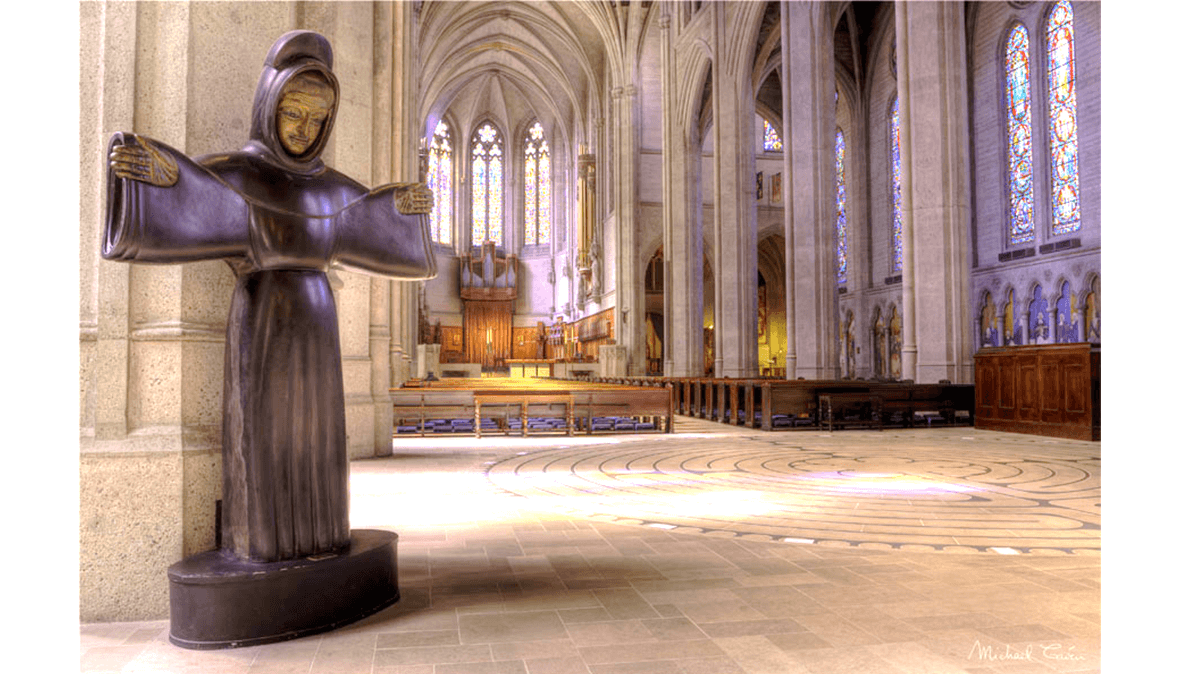
I had become disillusioned with the Catholic Church as a teenager but Pope Francis gave me hope for a few reasons. First, he chose his papal name Francis after Saint Francis of Assisi, who is well known for his love of animals (referring to them as our brothers and sisters) and rejection of the accumulation of material goods. Funnily enough, I wandered into Grace Cathedral in San Francisco on Easter Sunday (to light a candle for my dearly departed cat) and found myself facing a statue of St. Francis just a few hours before Pope Francis passed.
Second, Pope Francis made a point of living modestly – choosing a Vatican guest house over the official residence and saying no to extravagances such as limousines. He stated that he wanted the church to serve the poor.
On the night he was elected he shunned the papal limousine and travelled on a bus with other cardinals. He went to the Church-run hotel where he had been staying before the conclave and insisted on paying the bill. – Reuters.
Third, two years into his papacy, Pope Francis published a book on climate change and inequality. He chose to tackle the most critical environmental issue and the most critical social issue that we face on Earth. You can read the entire book, subtitled On Care for Our Common Home, on the Vatican website.

On Care for Our Common Home
When we think about leaders, whether of a church or a country, isn’t it nice when they actually care about the people and the planet? Here are a few quotes from Pope Francis’s Encyclical on Climate Change and Inequality:
I believe that Saint Francis is the example par excellence of care for the vulnerable and of an integral ecology lived out joyfully and authentically. He loved, and was deeply loved for his joy, his generous self-giving, his openheartedness. He was a mystic and a pilgrim who lived in simplicity and in wonderful harmony with God, with others, with nature and with himself. He shows us just how inseparable the bond is between concern for nature, justice for the poor, commitment to society, and interior peace.
The poverty and austerity of Saint Francis were no mere veneer of asceticism, but something much more radical: a refusal to turn reality into an object simply to be used and controlled.
Global inequality
In different ways, developing countries, where the most important reserves of the biosphere are found, continue to fuel the development of richer countries at the cost of their own present and future.
The export of raw materials to satisfy markets in the industrialized north has caused harm locally, as for example in mercury pollution in gold mining or sulphur dioxide pollution in copper mining.
Indeed, when all is said and done, [the poor] frequently remain at the bottom of the pile. This is due partly to the fact that many professionals, opinion makers, communications media and centres of power, being located in affluent urban areas, are far removed from the poor, with little direct contact with their problems.
Today, however, we have to realize that a true ecological approach always becomes a social approach; it must integrate questions of justice in debates on the environment, so as to hear both the cry of the earth and the cry of the poor.
Climate change and biodiversity
Climate change is a global problem with grave implications: environmental, social, economic, political and for the distribution of goods. It represents one of the principal challenges facing humanity in our day.
Things are made worse by the loss of tropical forests which would otherwise help to mitigate climate change. Carbon dioxide pollution increases the acidification of the oceans and compromises the marine food chain.
Each year sees the disappearance of thousands of plant and animal species which we will never know, which our children will never see, because they have been lost forever. The great majority become extinct for reasons related to human activity.
A delicate balance has to be maintained when speaking about [rainforests] for we cannot overlook the huge global economic interests which, under the guise of protecting them, can undermine the sovereignty of individual nations. In fact, there are “proposals to internationalize the Amazon, which only serve the economic interests of transnational corporations.”
Introduction
The introduction was written by Naomi Oreskes, co-author of Merchants of Doubt (discussed previously on the GSP). Prof. Oreskes sums up the book as follows:
Pope Francis’s Encyclical is a call to action that insists that we embrace the moral dimensions of problems that have been heretofore been viewed primarily as scientific, technological, and economic.
Pope Francis’s solutions: A change in mindset & ethical consumption
Above all else, Pope Francis calls for a change in mindset and a realization that our individual actions matter. The words consumption/consumers turn up in Pope Francis’s short book on climate change and inequality 64 times.
Many people know that our current progress and the mere amassing of things and pleasures are not enough to give meaning and joy to the human heart, yet they feel unable to give up what the market sets before them. In those countries which should be making the greatest changes in consumer habits, young people have a new ecological sensitivity and a generous spirit, and some of them are making admirable efforts to protect the environment. At the same time, they have grown up in a milieu of extreme consumerism and affluence which makes it difficult to develop other habits. We are faced with an educational challenge.
By learning to see and appreciate beauty, we learn to reject self-interested pragmatism. If someone has not learned to stop and admire something beautiful, we should not be surprised if he or she treats everything as an object to be used and abused without scruple. If we want to bring about deep change, we need to realize that certain mindsets really do influence our behaviour.
Our efforts at education will be inadequate and ineffectual unless we strive to promote a new way of thinking about human beings, life, society and our relationship with nature. Otherwise, the paradigm of consumerism will continue to advance, with the help of the media and the highly effective workings of the market.
…spirituality proposes an alternative understanding of the quality of life, and encourages a prophetic and contemplative lifestyle, one capable of deep enjoyment free of the obsession with consumption
A change in lifestyle could bring healthy pressure to bear on those who wield political, economic and social power. This is what consumer movements accomplish by boycotting certain products. They prove successful in changing the way businesses operate, forcing them to consider their environmental footprint and their patterns of production. When social pressure affects their earnings, businesses clearly have to find ways to produce differently. This shows us the great need for a sense of social responsibility on the part of consumers. “Purchasing is always a moral – and not simply economic – act”.
Epilogue
Since Jorge Mario Bergoglio became Pope Francis in 2015, I’ve found myself occasionally attending churches (often at someone else’s suggestion, to be honest). Most of my experiences have been positive but it’s interesting that these positive experiences have usually been at modest, often underfunded churches. One of them takes part in a second chances program – the music is led by a former inmate of San Quentin prison.
There was one exception – a well-funded church in a wealthy area on the eastern edge of the Bay Area. I was honestly shocked at how the sermon sounded like a libertarian manifesto. The pastor talked about how we feign interest in other people’s problems – but this wasn’t a cautionary tale, he was basically just saying that this is how we are now! He went on to discuss how you can manifest luxury cars or whatever you want in life. The pastor lives a lavish lifestyle and, as it turns out, the church is heavily attended by Trump supporters.
Whatever you believe, don’t believe for a moment that it’s okay to ignore the fate of the planet or to turn your back on the poor. Happy Earth Day!
“Hope” is the thing with feathers –
That perches in the soul –
And sings the tune without the words –
And never stops – at all –
For Sparkles, the sweetest cat, and Pope Francis, the kindest Pope
Discover more from The Green Stars Project
Subscribe to get the latest posts sent to your email.
