

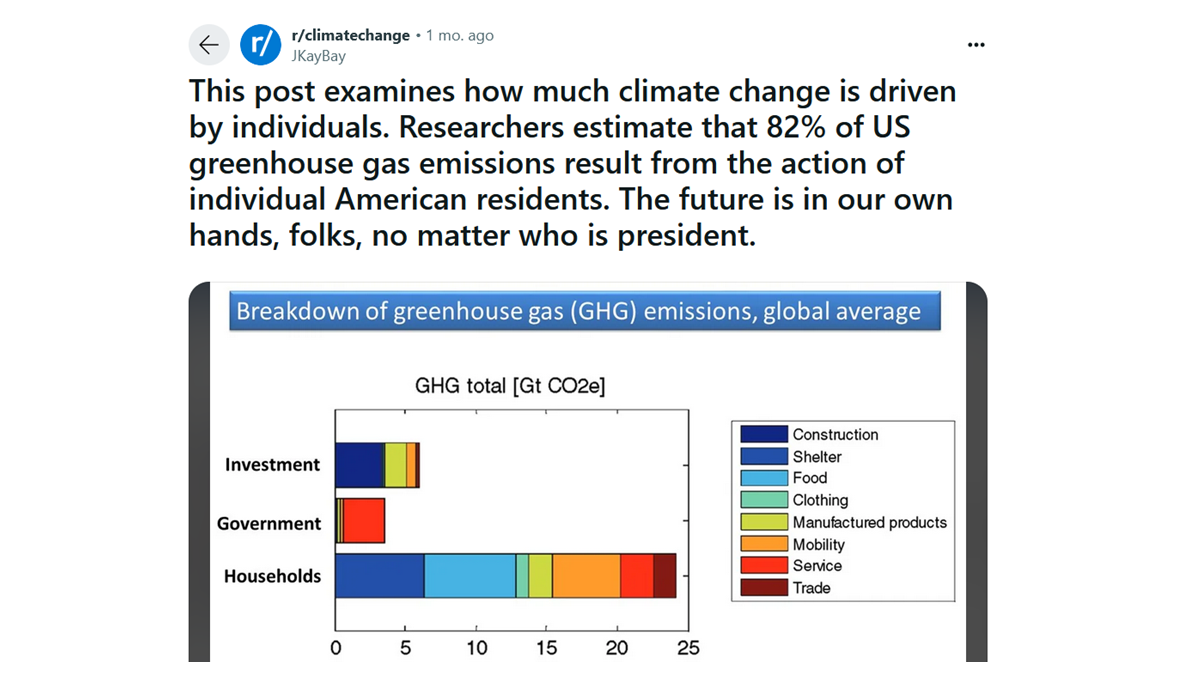
This is a follow-up to my post on the US election result & climate change, which looked at the contribution of our individual lifestyles to total global greenhouse gas (GHG) emissions. In that post I argued that since individual US residents are responsible for an estimated 82% of America’s total GHG emissions, our personal actions matter an awful lot, regardless of who sits in the White House.
Yes, government legislation & regulations (renewable energy adoption, etc.) are hugely important and of course the incoming government is not good news from a climate perspective. But that just underscores how important our personal actions are – they are all we can rely on, for a while.
I shared that post on Reddit and received plenty of abuse for it. In a way, I’m not too surprised – these are highly troubling times and the topic of climate change will always attract hecklers. But most of the responders were especially rankled by the idea that responsibility might lie at their feet, and the backlash was a little disturbing, to be honest. There was a general vibe of, don’t tread of me and/or don’t tell me it’s my fault – it’s the corporations and the government. Here’s a concise response typical of that category:
Nope. Make the corporations change first. Stop making MY life harder.
There were accusations flying that I, or the scientists behind the study, were pushing an agenda to let Big Oil off the hook. There was also a suggestion that my only purpose in sharing the data is to hawk “woke” products. So the perception of me by Reddit critics alternated between the two extremes of Big Oil shill and Woke Inc. shill.
Many of the responses had a weird tone – a mixture of victim (Stop making my life harder, or I guess I should just go live in a cave then.) and aggressor. But actually, now that I think of it, this victim/aggressor mix reminds me of most bullies that I’ve met – or watched on TV in Presidential debates. After responding to a few of the Redditors I decided that it was best to let them debate it amongst themselves.
Critics of ethical consumption
I’ll share the most upvoted critical comment below – it’s in the typical Reddit style of let me educate you on how the world works. The comment was in response to a thread on supporting ethical companies and how corporations will only make items that people buy (supply and demand).
Supply and Demand theory is useless when you exist in a monopolistic oligarchy, as well as a system that minimizes cost to maximize profit. The cheaper option will always be worse off for the planet, and in today’s financial crises, everyone wants the cheaper option.
At least they avoided the usual mantra of no such thing as ethical consumption under capitalism, but it’s based on the same premise. Rather than repeating it here, I’ll refer you to a post that addresses that topic: is there such a thing as ethical consumption under capitalism?
The commenter makes things sound hopeless (and they used the phrase monopolistic oligarchy, so…they know!) and everyone says yep, votes for the comment, and gets on with their life-as-usual. But, to be fair to the Reddit community, many people were supportive and the comment that received the most upvotes was on the side of reason:
Buying beef instead of beans is not on the corporations, and there’s basically no way to create sustainable beef. It’s easy to blame others so we don’t need to change, but that won’t be enough.
Couldn’t have said it better myself. So here are a few points related to these top two comments:
- What we buy matters a lot – sometimes much more than which company supplies it. The choice to buy legumes instead of beef is a perfect example.
- There are many cases where the cheaper option is much better choice for the planet – legumes are considerably cheaper than beef, for example. In my original post I had discussed a paper that estimated money saved via various strategies to reduce GHG emissions in US households. I’ll show a key chart from that study again below and bear in mind that it doesn’t show all strategies – there are several other ways to reduce GHG emissions while also saving money. Three good examples are wasting less food, buying used items, and simply buying less stuff. All of these strategies will help us get through “today’s financial crises.”

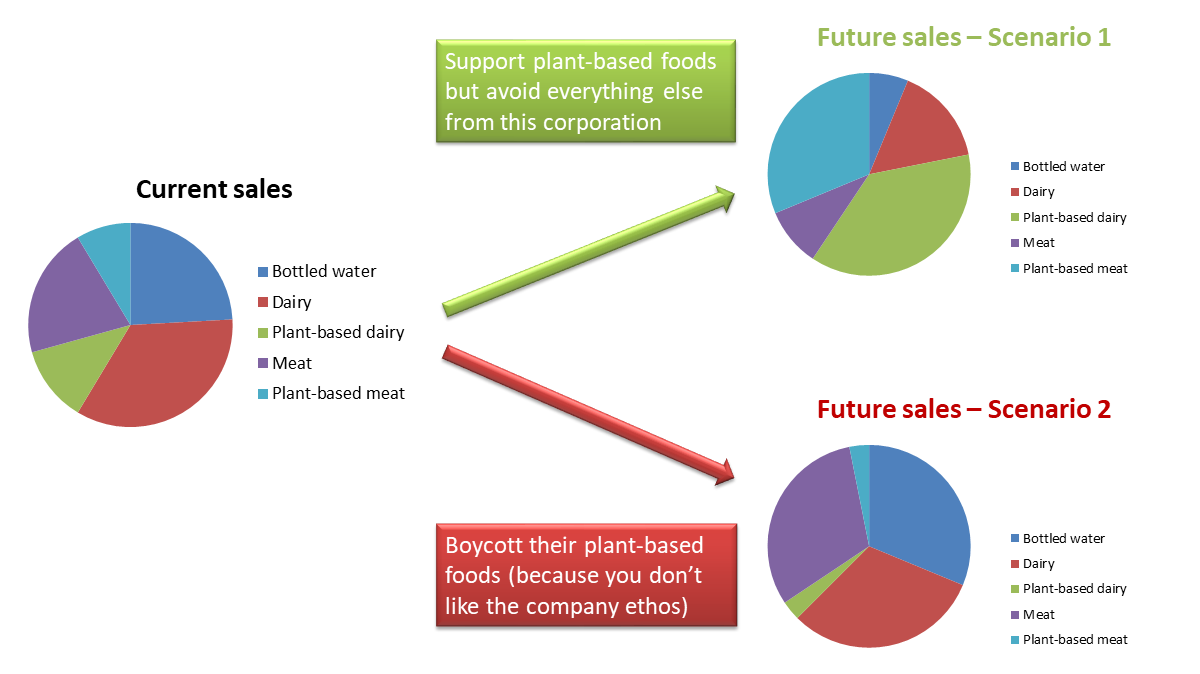
Yes, it’s frustrating that some markets are dominated by just a few companies. However, with the exception of certain products (e.g., software or gasoline) it’s usually easy enough to avoid the biggest players, if you want to. But even if your choices are very limited, choosing the right kind of product (such as plant-based food) will have a positive impact, even if it’s made by one of the giant food corps. See previous GSP posts on vegan foods and other ethical brands that are owned by mediocre multinationals for more on that. Or simply cast your eye downwards, to the wondrous PowerPoint image that summarizes my thesis on that.
The importance of plant-based food
Why do I keep on going on about plant-based food? Well this is my last post of the year so indulge me and think of this as a wrap-up of the main GSP themes of 2024. One reason I emphasize the adoption of plant-based diets so much is because it’s the one thing that everyone can work towards. Redditors point out that they have no public transit route to work and can’t be expected to bike 80 miles a day. But they can try a vegan burger instead of a beef burger – they are actually very good, these days, so it hardly even qualifies as a sacrifice.
But it’s not just because eating more plant-based food is an accessible action – it’s also the top action for most people. The critical importance of plant-based diets is the reason I started the GSP sister-site Ethical Bargains. On Ethical Bargains, I review items bought on discount at the Grocery Outlet, one of the best places to find cheap vegan food in America.
Adopting a plant-based diet is the top thing you can do to mitigate climate change, deforestation, animal cruelty, and food scarcity. – The first point I’ll usually make when reviewing vegan products over on Ethical Bargains.
Challenges in America
For sure we face structural challenges – America needs more renewable energy and more regulation and accountability for industries such as fossil fuels and plastics. But we also have to acknowledge that these industries are driven by consumer demand and the fact is that North Americans consume more stuff than most other people on earth. Just look at the amount of trash generated as a proxy:
The amount of municipal solid waste (MSW) generated per capita, worldwide, correlates fairly well with income and cultural norms. EU residents, on average, generate 1.4 kg (3 lbs.) of MSW per day while US residents generate around 2.3 kg (5 lbs.) daily, most of which ends up in landfills. – My upcoming book.
Americans generate around 65% more trash than EU residents and about twice as much as residents of Japan. This metric and others such as per capita expenditure (see also, total expenditure versus spending on food alone) and beef consumption help to illustrate why Americans have high carbon footprints. Of course, these numbers are averages and your footprint can be high or low, no matter where you live (many in America do manage to lead low-impact lives). As discussed previously, those with higher incomes tend to have larger footprints and therefore have a greater responsibility to reduce these footprints.
Pessimism and its antidote
It seems that it’s becoming a cultural norm to look for someone else to blame rather than taking responsibility for our own personal actions. I encounter this all the time when I talk to people about the book (on ethical consumption) that I’m writing. The most common response is basically that people – especially people in America – don’t want to change their habits. There’s also a dangerous implication here: everyone else is giving up, so why shouldn’t I? This is somewhat similar to the concept of anticipatory obedience, for example media group owners making concessions to Trump even before he takes power.
Here’s my suggestion: stop worrying about what everyone else is doing, stop anticipating failure, and just focus on your own actions. Ironically, it’s when we focus on our own personal impact – in earnest rather than through lip service – that others are far more likely to notice and follow suit. The approach of simplifying our lives and making the right choices can bring peace, and if there’s one thing everyone craves right now its peace.
Consumer actions matter, even when options are limited
No matter how pessimists and critics like to spin things, the laws of supply and demand still prevail. Even in situations when our options are limited to the big players, our choices will co-create the future direction of these corporations and the landscape of what they sell.
I’ve recently examined a few cases where our consumer habits drive the direction of individual corporations – the product range, supply chain, use of third-party certifications, etc. I’ve discussed how mediocre brands such as Ben & Jerry’s or Boursin have created plant-based products that are significantly better than average in terms of social and environmental impact. These companies will happily sell us either dairy-based or plant-based products, depending on the level of consumer demand for each. In other words, most corporations are fairly agnostic about what they sell, as long as they can make a profit.
I like to keep track of Starbucks, a company with a mixed social and environmental track record, because it’s an interesting barometer of society’s behavior. Starbucks, for example, responded to Trump’s 2017 immigration bans by hiring thousands of refugees, but the company is also a massive generator of disposable cup waste. I recently highlighted the large incentive Starbucks now provides to bring your own reusable mug – an immediate discount and also bonus stars that allow you to quickly earn free coffee beans. A failure to adopt this habit, which saves customers money and mitigates one of Starbucks’ biggest negatives, is largely on consumers.
I’m not saying that Starbucks ranks highly for ethics – it’s a mix of good and bad and I would still rate it around 2.5 Green Stars for social and environmental impact. (I’m trying to avoid people who have skimmed the post from jumping down my throat!) I’m just using it as an example of how our habits and behaviors as consumers mold the companies that supply us, making them either better or worse.
Seeking out alternatives to the dominant corporations is often the best approach when purchasing ethically-sensitive products. This applies especially to products from the Global South (e.g., chocolate) where it’s best to avoid commodity market supply chains and seek out companies with more direct trade relationships. In 2025, I will continue to research and report on the best concrete actions that we can take, as consumers, to mitigate our global social and environmental challenges.
Thank you for reading and wishing you all a peaceful new year.
Discover more from The Green Stars Project
Subscribe to get the latest posts sent to your email.
