

Earlier this year, organic cereal maker Cascadian Farm released a limited edition cereal made with a perennial grain called Kernza. I decided that this was a good excuse to research the grain, which has cropped up in a few products now, including two from Patagonia. The full review of the cereal is on my other blog (Ethical Bargains) and includes an evaluation of the cereal’s maker, Cascadian Farm, founded in 1972 and now owned by General Mills.
Reviewing products on Ethical Bargains often entails going down rabbit holes and researching topics that really merit their own posts. So, with that in mind, here’s some research that examines the promise of Kernza as a sustainable grain.

What is Kernza?
Kernza is a kind of wheatgrass whose deep roots survive in the soil over winter and produce a crop each year for a few years – that is to say, it’s perennial. Some environmentalists are excited about it because it could offer benefits to soil systems over annuals such as wheat. Others are skeptical because of the lower crop yields – I’ll get into that later. The grain, commonly known as intermediate wheatgrass (Thinopyrum intermedium), was developed and trademarked as Kernza® by The Land Institute. Founded in 1976, The Land Institute is a science-based nonprofit research organization that’s working “to develop an alternative to current destructive agricultural practices.”
Kernza® grain plants are deeply rooted. The roots can extend 10 feet or more beneath the soil surface, delivering atmospheric carbon to the soil and efficiently taking up nutrients and water.
Kernza is still an experimental crop, only planted on a few thousand acres globally and it’s not going to be taking over your supermarket shelves until crop yields improve. For now you can find Kernza in niche products such as this cereal and a couple of products (beer and pasta) from Patagonia. You can also buy Kernza as a whole grain or flour from Perennial Pantry (almost $10 for 14 oz.) if you’d like to try baking with it.
Is Kernza sustainable?
Let’s start by looking at what Patagonia has to say about the grain:
A revolutionary new grain called Kernza® is igniting a movement to feed the world while restoring damaged soils and protecting groundwater from nitrogen pollution.
Kernza is a perennial, remaining in place year after year. This allows it to develop a complex web of roots that nourish the microbiome of the topsoil. Meanwhile, those penetrating roots allow the plant to find underground water and nutrients that remain inaccessible to annuals.
Patagonia also mentions some nutritional advantages of Kernza over its annual cousin, wheat:
Compared to annual wheat, a better source of fiber, plant-based protein, and essential amino acids. Kernza also contains higher levels of the carotenoids lutein and zeaxanthin.
Environmentalists usually think of Kernza as a replacement to wheat, so this is probably the best comparison to make, when evaluating environmental impact.
Kernza versus wheat: yields
Wheat is a pretty good crop when it comes to nutritional value and environmental impact, so the bar is fairly high here. It would be much easier to argue that Kernza is a better choice than red meat but that’s not the most appropriate comparison. Right now, Kernza does not look good in terms of environmental impact, in comparison to wheat, because:
- The yield per acre of Kernza is much lower than that of wheat: typically around one quarter that of conventional winter wheat in year 1.
- Kernza yields drop after year one, suggesting that Kernza doesn’t bring the benefits of a perennial grain. An evaluation of published yields indicates that yields tend to decline from year 2 onwards (see table, below).
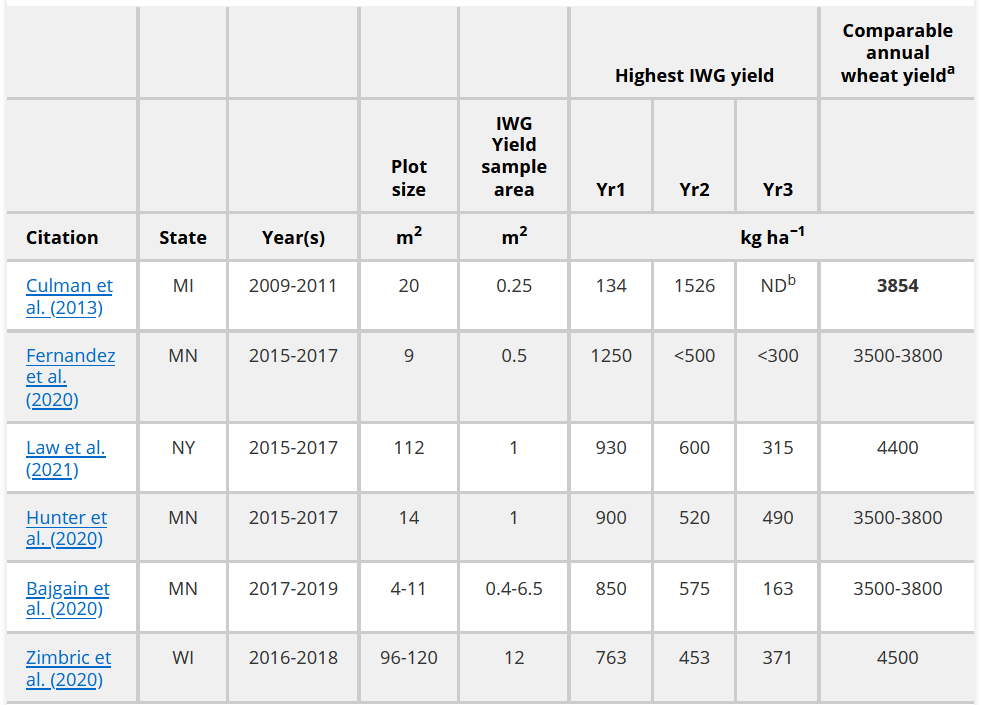
It’s important to grow crops with reasonably high yields if we want to feed everyone on the planet without further deforestation. A yield per acre that’s four times lower than that of wheat is acknowledged to be too low to be viable. The drop in yield over time could be an even bigger issue – if Kernza yields drop by 30-40% after year one then is there any benefit to it being a perennial crop?
It’s no secret that the yield of Kernza needs to improve and this is a major research focus of groups, such as The Land Institute, that are working to breed improved varieties of the grain.
Kernza is high in protein: this impacts the sustainability assessment
Flour made from Kernza grain is almost 20% protein while conventional wheat flour is around 12% protein. Considering that 20% protein is close to the protein content of meat, this changes the perspective on Kernza a little.
Many studies on the environmental impact of food (such as Poore and Nemecek’s seminal paper) evaluate the footprints (land, water, energy, etc.) in terms of the nutritional content of the food. So, with Kernza’s protein content being around two thirds higher than that of wheat, the gap between Kernza and wheat becomes a little narrower if expressed in terms of protein per acre. In other words, the yield of Kernza grain is only 25% that of wheat grain, but the yield of Kernza protein is around 38% of that of wheat protein. So a 2.6-fold improvement in Kernza yield would bring the two grains close to parity in terms of protein yield per acre.

So, in summary, Kernza might become commercially feasible and environmentally appealing if the yield is at least doubled and can also be maintained for two or three years. If this can be achieved then there’s a good likelihood that Kernza will offer some advantages over annuals such as wheat or rice. Benefits could include reducing herbicide use and water pollution, increasing biodiversity, preventing soil erosion, and storing soil carbon.
Conclusion: Kernza is currently not more sustainable than wheat but may be, one day
Kernza is not currently more sustainable than wheat because of its significantly lower crop yield. Improving the Kernza yield will take some work and may not reach fruition, but I think it’s worth a try.
Perennial crops generally offer environmental benefits largely because new crops don’t have to be planted each year – think of a walnut tree that can produce nuts for years. The breeding of new perennial versions of our staple crops is a worthy goal for the sustainable agriculture community. A variety of perennial rice has been developed that reportedly matches annual rice yields of over eight consecutive harvests and has been adopted by farmers in China.
I’ve been posting more on Ethical Bargains than here on the GSP (my last post here was January! Is time accelerating for everyone else too?) So, if you’re interested in ethical consumption, climate change, food sustainability, plant-based food, etc., consider subscribing to Ethical Bargains, which focuses on reviewing products and rating them for social and environmental impact.
Discover more from The Green Stars Project
Subscribe to get the latest posts sent to your email.
 The Green Stars Project
As a vegetarian, I’m always on the lookout for high-protein grains. I’ve never heard about Kernza, but would be willing to try it.
LikeLiked by 1 person
I enjoyed the cereal so it’s worth a try, I think.
Perhaps buying the pure grain or flour is a good way to experiment with it.
LikeLiked by 1 person
Thanks for the tip.
LikeLiked by 1 person