

In this post I’m going to do an ethical review of shoes from an Australian brand, Etiko, and decide on an ethical (Green Stars) rating. Since turning vegetarian at 15, I’d relied quite a bit on Converse High Tops as my go-to leather-free shoes. Converse used to make shoes in the US but eventually went bankrupt and was bought by Nike, who moved production to Asia. I’ve looked at Converse shoes in a previous post, so I’ll refer you to that ethical review of Converse for more detail. I concluded that Converse High Tops are better than your average shoe but highlighted two key areas for improvement:
- Labor conditions: A fair trade certification (or equivalent) for supply chain and manufacturing.
- Sustainability of raw materials: Inclusion of natural rubber and organic cotton (or hemp) canvas.
There’s now a much wider variety of non-leather shoes available and some of them show progress on addressing social and environmental issues. So I’m going to take a look at how Etiko has addressed the issues that I highlighted above, followed by an ethical review and a Green Stars rating.

Etiko shoes: Labor conditions
Anyone who has looked at the clothing and footwear industries knows that factory working conditions are often grim, with long hours, poor conditions and low pay. In 2006, Etiko became the first clothing company in the southern hemisphere to switch to a fair trade model. On their blog, Etiko provide some examples of how much difference the fair trade premium can impact quality of life for workers in their factory in Pakistan. The fair trade certification applies not just to the workers who assemble Etiko’s shoes and clothes but also to the farmers who supply raw materials such as cotton. Farming of cotton, like any commodity crop, is a tough business, especially in developing countries.
You may have heard that many cotton farmers in India commit suicide every year due to bankruptcy – the death toll is estimated at 300,000 people over the last two decades. The topic of cotton farming is so thorny that I ended up spending a lot of time researching it and decided to that it needs its own post (coming soon). Briefly, the underlying reason for farmer suicides is economic: Small farmers trying to compete with larger farms go into debt with local moneylenders to cover the costs of seeds, fertilizer, herbicides and insecticides and then, if crop yields suffer or market rates are not ideal, the high interest on the debt becomes financially crippling. A way for small farmers to escape this cycle is to switch to a more sustainable farming method and get a safety net to protect against market fluctuations. A fair trade agreement provides farmers with two crucial safety nets:
- A minimum market price that protects against fluctuations in the commodity market.
- An additional 15% price premium that can be used to improve farming practices, health, education etc.
Fair trade programs also include standards that protect workers’ rights and prohibit unethical practices like child labor. I’ve summarized the benefits of fair trade before in this post on coffee, and the same principles apply to other commodity crops such as cacao, sugar, or cotton.
Etiko shoes: Sustainability of raw materials
The cotton used in Etiko’s products is certified organic by GOTS (Global Organic Textile Standard), one of the best certifications to look for. Cotton production has had devastating consequences worldwide, from the “everyday” impact of soil, water and habitat degradation to extreme cases like the drying up of the Aral Sea (formerly the 4th largest lake in the world) to become a pesticide-laden dustbowl that’s causing all kinds of health problems for millions of people. I’m going to go into the benefits of organic cotton in the next post, but (spoiler alert!) my conclusion is that it’s a good thing. The GOTS organic textile certification doesn’t just cover farming of the crop but also production and dyeing of the fabric. As you’re probably aware, clothing has a huge impact and is a major source of pollution in developing countries, for example the Citarum river in Indonesia.
Rubber from a living forest
Most shoe companies, like Nike, use rubber that’s made from petrochemicals, but rubber can also be made by tapping rubber trees. When I think of rubber tapping I think of Chico Mendes, one of my childhood heroes, who fought for rubber tappers rights and preservation of the Amazon rainforest – it has been more than 30 years since his assassination by cattle ranchers but his spirit lives on in the fight for rainforest rights. Etiko uses FSC-certified rubber that’s tapped in Sri Lankan forests for their high top sneakers and incorporates recycled rubber into some of their other products. There’s a phrase in the forestry industry that has often borne out: The forest the pays, stays. There are several products that can be produced in harmony with existing or newly planted forest: shade-grown coffee and cacao, gum, and rubber, to name a few. As mentioned in a previous post on gum, the sustainable harvest of products from rainforest can help preserve the forests and give locals and alternative to leaving their home (or leveling it to switch to cattle ranching). It is important to check that the company provides some assurance on sustainability of their supply chain, such as FSC-certification.
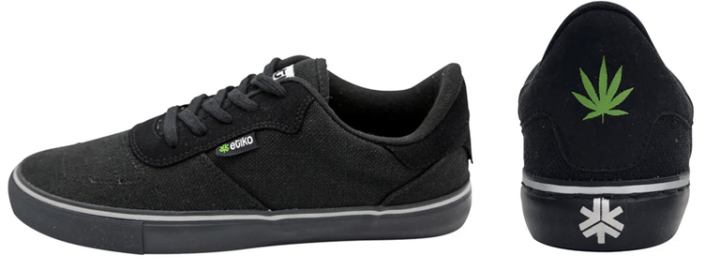
Hemp shoes from Etiko
Etiko have now started using hemp as a material for shoes – this is welcome news as hemp is considered to be one of the most sustainable textiles. In two previous posts, I looked at the footprint of various textiles, both in terms of energy and material inputs and impact during processing and use. Hemp came out as a top choice (along with linen and a couple of modern textiles such a lyocell, aka Tencel). Organic cotton is better than conventional cotton (in my opinion) but hemp tops both.
Etiko – sustainability of company operations
I’ll summarize the key points in my ethical review, below but I’ll fill in a few details here. Etiko are certified by B Corporation, a non-profit organization that scores companies on various social and environmental criteria such as worker benefits, supply chain, and environmental footprint. Etiko offsets the company’s carbon footprint by funding tree planting in Timor-Leste.
Our first CRI report showed that Etiko’s carbon footprint was: 66.48 tonnes of greenhouse gas emissions. This is significantly lower than the industry standard, but not good enough for us. We are now on track to a net-zero carbon emissions target by 2020 for our entire supply chain. The Australian fashion industry has set its target for 2050.
One of the ways we offset emissions is by purchasing ethical, social environmental carbon credits from Timor-Leste via Carbon Social. The organisation works with subsistence farmers in Baguia to replant trees, improve livelihoods and build village economies.
Etiko also has a Take Back Program for recycling of worn out sneakers and flip flops.
My new shoes from Etiko
I had a serious footwear shortage and ended up buying two pairs of shoes (high tops and hemp) and a T-shirt from Etiko, so they could all be shipped together. I know I could have been a better citizen by searching for shoes in thrift stores – I will try harder! I was happy to see that the packaging was minimal (FSC-certified cardboard box and compostable wrap) and initially I considered the fact that they will be shipped from Australia, but realized that this is not a significant factor. The reality is that the majority of shoes are assembled in Asia from materials collected from around the world and then shipped to a warehouse, and then a store. There is probably less shipping involved overall when shoes are shipped directly from Etiko. I’ve had the shoes for about four months now and have to say that they are holding up pretty well – they still look about new. The high tops feel about the same as my old Converse did and the hemp shoes are comfy and warm. The high tops didn’t cost much more than regular Converse (and less than special edition Converse), so it’s good to see ethical footwear becoming available at fairly affordable prices.
Ethical review of Etiko
Here’s a summary of the key factors that I considered when scoring Etiko:
- All shoes are vegan – no animal-based materials or glues
- The cotton used to make their canvas uppers is organic and fair trade certified
- The factory where shoes are assembled is also fair trade certified, providing a better standard of living for workers
- They have a new line of shoes made from hemp, one of the most sustainable textiles
- Their rubber for their shoe soles is tapped from rubber trees in Sri Lanka and is certified by the Forest Stewardship Council (FSC)
- Etiko is a certified B-corporation and finances tree planting to offset their carbon footprint.
- Packaging is FSC-certified cardboard and paper
Overall, I think Etiko deserves 5/5 Green Stars for social and environmental impact. I don’t buy stuff unless I really need it, and I’m disappointed when I come across ethical fashion that’s just too expensive or, worse, falls apart quickly. Etiko have delivered on being competitive with Converse shoes in terms of price and quality while also raising the bar on ethics.
Discover more from The Green Stars Project
Subscribe to get the latest posts sent to your email.
 The Green Stars Project
Thank you! I’ve been looking for ethical fashion brands for a while now. Will be adding Etiko to my list :).
LikeLike
Thanks Aswathi! Hope you’re keeping well up there 🙂
LikeLike
Very helpful review. Thanks. Hadn’t heard of this brand before.
LikeLiked by 1 person
Thanks Elaine 🙂
There not that well known, especially as you don’t see them in stores. Hope they will take off like Veja did. How are things going there?
LikeLike
Great and informative post. The consumers need to be informed and to begin making responsible decisions. These issues often do not make our news feeds, so posts like this are vital. Thank you for the ‘eye-opener.’
LikeLiked by 1 person
Thanks Mark! Yes, our news feeds are even more selective than normal at the moment
If we want to change the planet I’m hoping that we start taking lessons from COVID-19 to help us take on the bigger planetary threats of climate change, inequality, and habitat destruction.
LikeLike
Thank you for this!
LikeLiked by 1 person
Thanks for reading, Pam!
Hope you are well.
LikeLike
And you as well!🥰
LikeLiked by 1 person
Go Aussie! Had not heard of these.
LikeLiked by 1 person
5 out of 5 Green Stars… well earned. We need more companies like this to demonstrate that profit and ethical partnerships can be synonymous. We also need more rating systems like The Green Star Project to help consumers reward these companies that don’t have multi-million dollar marketing budgets.
LikeLiked by 1 person
Very true, Cecelia. It levels the playing field somewhat.
LikeLike
Oh brilliant I am going to have a look online for some new speakers from them. Great review, very comprehensive 👍
LikeLiked by 1 person
Sneakers rather than speakers hehe
LikeLike
Eventually I’ll need a new pair of shoes (my last pair of 25+ year old vegan docs are showing their age, but they lasted a LONG TIME!), but I need a pair that provides support. How do these do for being on your feet and walking around a lot? Or do you have other recs?
LikeLiked by 1 person
That’s impressive, Willow!
I’ve worn Converse for year and quite like flat shoes. However, when you walk a lot they don’t last so long. Converse is now making shoes with much thicker soles, which seems like a good thing, as that’s usually the part that wears out first.
The Etiko shoes are pretty comparable to Converse, so they may not be for you.
My tip – try shopgoodwill.com, search for your shoe size and examine the photos. I’ve bought shoes from Allbirds (through Goodwill) that clean up nicely in the washing machine and have lasted well. You’ll appreciate this – I’ve also bought shoes that are commonly sold at Walmart and found the quality to be appalling. They were barely worn when I bought them but started falling apart pretty quickly. But at least since I bought them on Goodwill, it was a fairly cheap experiment.
I’ve bought several pairs on Goodwill now and most have been decent.
LikeLiked by 1 person
Yes, the smell from the shoe aisle alone is overpowering. Can you imagine working in the factory that makes those things? I’ll try that Goodwill site…I didn’t know they had an online store. I just was at Goodwill and didn’t see any shoes but did get a Crockpot that was exactly my size (and looked brand-new!). Ha!
LikeLiked by 1 person
haha – glad it was of some use!
LikeLike
I found two pairs of Docs on there with vegan leather in my size and all! Unfortunately I don’t have them in my budget right now what with the move, but good to know there are options!
LikeLiked by 1 person